
Unit 5
Peoples and States of Africa to 1500
Introduction
- This unit is about the languages of the peoples of Africa and how they are grouped.
- Unit 2 already covered ancient Egypt, Kush and Carthage as part of the ancient and classical world civilizations.
- This unit looks at the peoples and states that grew strong in other parts of the continent up to 1500 AD.
- It gives a short description of the civilizations they built.
🎯 Learning Outcomes
- Outline the major economic, cultural, social, and political developments in pre-colonial Africa.
- Describe the peoples and language families of Africa.
- Analyse inter-connections and inter-dependence among Africans as a result of trade, population movements, and wars.
- Evaluate the factors for the rise and decline of various empires in Africa to the beginning of the 16th century.
- Explain the origin of Islam and the role it played during the expansion of the West African Empires.
5.1 Languages and Peoples of Africa
✏️ Brainstorming
What is a native language? Discuss in a group.
- Africa is a huge continent, and its people speak many different languages.
- Language experts say that more than 1,000 languages, connected to each other, are spoken across the continent today.
- Languages in the same group share some words, and experts study how closely languages are related.
- Using this, they put the peoples of Africa into four super-families of languages: Congo-Kordofanian, Afro-Asiatic, Nilo-Saharan and Khoisan.
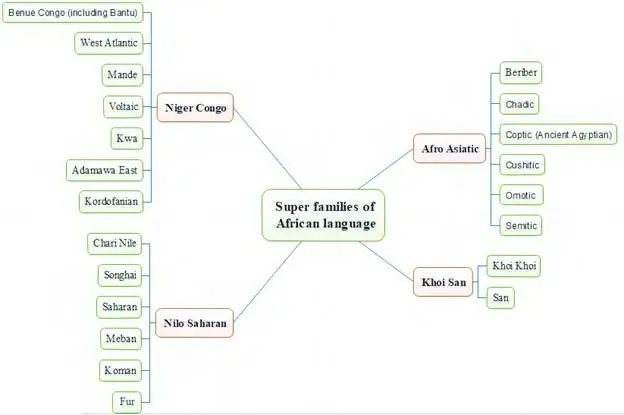
- Speakers of the Afro-Asiatic super-family live in northern Africa, the Sahara, the Horn of Africa and around Lake Chad.
- It has six sub-groups: Berber, Chadic, Coptic (Ancient Egyptian), Cushitic, Omotic and Semitic.
- The Semitic sub-group is spoken mainly in the Horn of Africa.
- The Omotic sub-family is spoken only in Ethiopia.
- The Cushitic branch stretches from the Red Sea coast, through the Horn of Africa, into central Kenya and Tanzania.
- According to rough estimates, the Niger-Congo super-family has the most speakers, and the Afro-Asiatic super-family comes second.
- Niger-Congo has two main branches.
- Niger-Congo proper covers much of West Africa and all of Bantu Africa.
- Kordofanian is spoken in a small area in the Nuba hills, south of the Republic of Sudan.
- Bantu speakers live across much of sub-Saharan Africa, and more than 450 languages belong to the Bantu family.
- Kiswahili belongs to this group.
- It is one of the most widely spoken African languages, and it is a mix of African and Arab cultures.
🔒
The rest of Unit 5 is in the Danulearn app
Read the full notes for all 9 sections, worked examples and figures, plus 18 exercises with step-by-step solutions, the Short Note and the unit review.
📑 Contents
- 5.1Languages and Peoples of AfricaPreview
- 5.2States in North Africa🔒
- 5.3Spread of Islam and its Impact in West Africa🔒
- 5.4States in Western Africa🔒
- 5.5Equatorial, Central and Eastern Africa🔒
- 5.6Southern Africa🔒
- 5.7Africa's Intra and Inter-continental Relations🔒
- 5.8Trans-Saharan Trade🔒
- 5.9Early Contacts with the Outside World🔒
✍️ Practice questions
5 questions from the Unit 5 quiz. Choose an answer, then check it.
- 1
According to the unit, over how many diverse languages are currently spoken across Africa?
- A100
- B500
- C1,000
- D5,000
Show answer
C 1,000
- 2
The peoples of Africa are classified into how many super-families of languages?
- Atwo
- Bthree
- Csix
- Dfour
Show answer
D four
- 3
Which African language super-family has the most speakers, according to rough estimates?
- ANiger-Congo
- BAfro-Asiatic
- CNilo-Saharan
- DKhoisan
Show answer
A Niger-Congo
- 4
Kiswahili, one of the most widely spoken African languages, belongs to which language group?
- ACushitic
- BBantu (Niger-Congo)
- CKhoisan
- DSemitic
Show answer
B Bantu (Niger-Congo)
- 5
The Khoisan super-family's speakers live mainly in and around which desert?
- Athe Kalahari
- Bthe Sahara
- Cthe Nubian
- Dthe Namib only
Show answer
A the Kalahari