
Unit 2
Ancient World Civilizations up to c. 500 AD
Introduction
- Unit 2 is about some of the most important civilizations of the ancient world.
- They grew up in Africa, Asia, America and Europe.
- You will study Egypt and Nubia in Africa.
- In Asia you will study Mesopotamia, Persia, India and China.
- In the Americas you will study the Maya, the Inca and the Aztecs.
- In Europe you will study Greece and Rome.
- The unit ends with how Christianity began and spread.
- Examples and pictures explain the main points, and there is a summary and review questions at the end.
🎯 Learning Outcomes
- Explain the major ancient world civilizations and their major achievements.
- Compare and contrast the ancient civilizations of Africa with those of Asia.
- Discuss how the ideas of civilizations were disseminated all over the world.
- Examine how ancient civilizations shaped the life of humankind.
- Describe the rise and spread of Christianity into different parts of the world.
2.1 Ancient Civilizations of Africa
✏️ Brainstorming
What do you know about ancient African Civilization?
2.1.1Ancient Egypt
- The civilization of Ancient Egypt began about 3000 BC and grew strong in the Nile Valley.
- According to tradition, Menes joined Upper and Lower Egypt into one kingdom around 3200 BC.
- Farming was the base of the Egyptian economy.
- Each year the Nile left fresh silt on the land, which made the soil rich again.
- Egyptian farmers could grow large amounts of wheat and barley.
- Livestock and trade also added to the economy.
- Egypt was a large state.
- It was ruled by an all-powerful king called a Pharaoh.
- He ruled through officials called Viziers, who worked as mayors, tax collectors and judges.
- People believed a Pharaoh was both a king and a god.
- They believed he became fully divine after death and watched over Egypt.
- The Egyptians worshipped many gods (they were polytheists) and believed in life after death.
- They preserved dead bodies, which is called Mummification.
- It slowly became a skilled art, and it helped Egyptian medicine to improve.
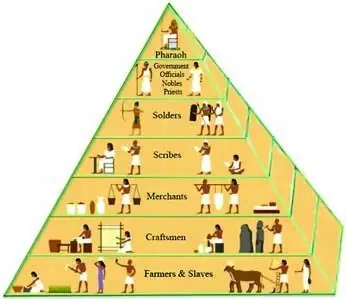
- Egyptian society had different levels, with the Pharaoh at the top.
- Peasants dug the irrigation channels.
- They also built the palaces, temples and royal tombs called Pyramids.
- Around 3000 BC the Egyptians invented a system of writing called Hieroglyphics.
- It used pictures, symbols for ideas, symbols for sounds, and signs that showed meaning.
- They also began to use Papyrus, a writing material like paper.
🔒
The rest of Unit 2 is in the Danulearn app
Read the full notes for all 5 sections, worked examples and figures, plus 15 exercises with step-by-step solutions, the Short Note and the unit review.
📑 Contents
- 2.1Ancient Civilizations of AfricaPreview
- 2.2Civilizations in Asia🔒
- 2.3Ancient Civilization of Latin America🔒
- 2.4Civilizations in Europe🔒
- 2.5The Rise and Spread of Christianity🔒
✍️ Practice questions
5 questions from the Unit 2 quiz. Choose an answer, then check it.
- 1
Ancient Egyptian civilization began about which year, flourishing in the Nile Valley?
- A5000 BC
- B3000 BC
- C1000 BC
- D500 BC
Show answer
B 3000 BC
- 2
According to tradition, Upper and Lower Egypt were unified by which ruler around 3200 BC?
- AMenes
- BTutankhamun
- CCleopatra
- DRamses
Show answer
A Menes
- 3
The absolute king of Egypt, regarded as both king and god, was called a:
- ACaliph
- BConsul
- CVizier
- DPharaoh
Show answer
D Pharaoh
- 4
Preserving the body after death through a skilled process is called:
- Amummification
- Bpolytheism
- Cpapyrus
- Dhieroglyphics
Show answer
A mummification
- 5
The ancient Egyptian writing system, developed around 3000 BC, was called:
- ASanskrit
- Blogographic script
- Ccuneiform
- Dhieroglyphics
Show answer
D hieroglyphics