
Unit 4
The Middle Ages and Early Modern World, c. 500 to 1750s
Introduction
- Unit 4 is about the main themes of world history in the Middle Ages and the early modern period.
- It has seven sections: the Middle Ages in Europe, the Middle Ages in Asia, the beginning of capitalism, the Age of Exploration, the Renaissance, the Reformation, and the Industrial Revolution.
- Examples and pictures explain the main points.
- At the end there is a summary and review questions.
🎯 Learning Outcomes
- Identify the major characteristics of European feudal society of the medieval period.
- Examine the main features of the Byzantine Empire.
- Discuss the rise and expansion of Islam during the period.
- Explain the relationship between Europe and the Ottoman Turkish Empire.
- Evaluate the major changes that took place during the medieval ages and the early modern times.
4.1 The Middle Ages in Europe
4.1.1 Dark Age
✏️ Brainstorming
What was the Dark Age?
- The “Dark Age” was a period in West European history from 500 AD to 1000 AD.
- It is called this because Civilization became weaker in Western Europe at that time.
- The Western Roman Empire was destroyed by two things: weakness and splitting inside the empire, and attacks from outside.
- In the 5th century AD the Anglo Saxons and Franks (Germanic tribes) and the Huns and Magyars (Asiatic tribes) overran the region.
- These invasions changed everything.
- Greco-Roman Civilization declined, society became more rural, and cities became smaller.
- Feudalism became the new social, economic and political order.
- Churches, castles and palaces were built.
- Bishops and monks kept records.
- Knights followed the rules of chivalry.
- Even so, wars between rulers and lords, murders and blood feuds were still common.
- By about 1000 AD, however, things became more stable, and feudal society came out of the Dark Ages.
4.1.2 Feudal Society
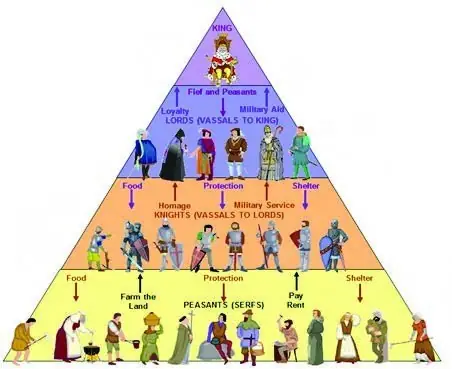
- As Western Europe fell apart, there were more and more separate, powerful lords and vassals.
- From 500 to 1500 a new social and political system called feudalism appeared.
- Its ruling class was made up of kings, nobles, Knights (soldiers) and the higher clergy.
- In the vassalage system, a higher lord gave a fief, which is a piece of land, to a lower lord.
- The lower lord became the vassal of the higher lord and gave him service in return.
- So feudalism was a system of holding land in return for service.
- The Roman Catholic Church owned land.
🔒
The rest of Unit 4 is in the Danulearn app
Read the full notes for all 7 sections, worked examples and figures, plus 17 exercises with step-by-step solutions, the Short Note and the unit review.
📑 Contents
- 4.1The Middle Ages in EuropePreview
- 4.2The Middle Ages in Asia🔒
- 4.3Development of Early Capitalism🔒
- 4.4The Age of Explorations and Discoveries🔒
- 4.5The Renaissance🔒
- 4.6The Reformation🔒
- 4.7Industrial Revolution🔒
✍️ Practice questions
5 questions from the Unit 4 quiz. Choose an answer, then check it.
- 1
The 'Dark Age' in Western Europe spanned roughly which period?
- A100-500 AD
- B1000-1500 AD
- C1500-1800 AD
- D500-1000 AD
Show answer
D 500-1000 AD
- 2
Under the feudal vassalage system, a piece of land granted by a higher lord to a lower lord was called a:
- Afief
- Bmanor
- Cestate
- Dpolis
Show answer
A fief
- 3
The basic unit of European feudalism, over which a manorial lord exercised power, was the:
- Amanor (village)
- Bparish
- Cduchy
- Dkingdom
Show answer
A manor (village)
- 4
The Byzantine Empire's capital was located at:
- ARome
- BAlexandria
- CAthens
- DConstantinople
Show answer
D Constantinople
- 5
The Byzantine Empire reached the height of its power under which emperor?
- AJustinian
- BConstantine
- CTheodosius
- DDiocletian
Show answer
A Justinian