
Temperature and Thermometry
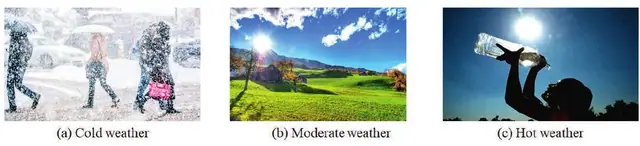
- Water in a shower feels hot, warm or cold, and the weather feels chilly or steamy.
- Our senses give only a rough judgement of how hot something is.
- In this unit you learn what temperature is, how it is measured on different scales, how thermometers work, and how solids expand when heated.
- Define temperature and describe its effects on daily life.
- Explain extreme-temperature safety and the causes and effects of rising global temperature.
- Describe the Celsius, Fahrenheit and Kelvin scales and the types of thermometers.
- Convert temperatures between the three scales.
- Calculate the linear expansion of solids.
- Touching a body to judge how hot or cold it is is not reliable.
- Warm water feels cool to a hand that was in hot water, and warm to a hand that was in cold water.
- Temperature: the degree of hotness or coldness of a body.
- It is a measure of the average kinetic energy of the particles of the body.
- A body whose particles have large kinetic energy has a high temperature.
- A body whose particles have small kinetic energy has a low temperature.
- People feel comfortable between 18 °C and 22 °C (room temperature).
Temperature affects our clothing, eating habits, health and even the economy.
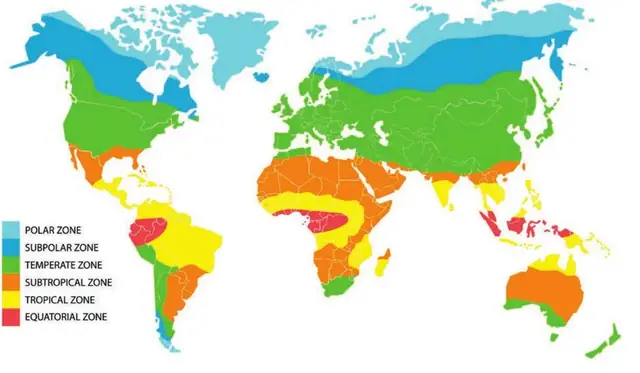
Temperature changes from place to place because the equator receives the most direct sunlight and the poles receive the least.
| Zone | Average temperature |
|---|---|
| Tropical rain forest | 21 °C to 31 °C |
| Temperate climate | −3 °C to 18 °C |
| Polar zone, summer | −14 °C |
| Polar zone, winter | −50 °C |
| Body | Temperature |
|---|---|
| Outer surface of the Sun | about 5600 K (≈ 5327 °C) |
| Ice | below 0 °C |
| Solid carbon dioxide | −78 °C |
| Liquid nitrogen | −196 °C |
1. How does temperature affect clothing, eating habits, health and economy?
2. Why does the wood feel warmer than a metal plate in the morning?
Read the full notes for all 7 sections, worked examples and figures, plus 7 exercises with step-by-step solutions, the Short Note and the unit review.
📑 Contents
- 7.1Temperature and Our LifePreview
- 7.2Extreme Temperature Safety🔒
- 7.3Temperature Change and its Effects🔒
- 7.4Measuring Temperature with Different Thermometric Scales🔒
- 7.5Types of Thermometers and Their Use🔒
- 7.6Conversion between Temperature Scales🔒
- 7.7Thermal Expansion of Materials🔒
✍️ Practice questions
5 questions from the Unit 7 quiz. Choose an answer, then check it.
- 1
Temperature is best defined as a measure of:
- AThe total energy of a substance
- BThe volume of a substance
- CThe average kinetic energy of the particles in a substance
- DThe mass of a substance
Show answer
C The average kinetic energy of the particles in a substance
- 2
Typical comfortable room temperature generally falls between:
- A-10°C and 0°C
- B40°C and 50°C
- C0°C and 5°C
- D18°C and 22°C
Show answer
D 18°C and 22°C
- 3
The average normal human body temperature is approximately:
- A37°C (98.6°F)
- B50°C
- C15°C
- D25°C
Show answer
A 37°C (98.6°F)
- 4
Environmental temperatures above about 40°C (105°F) raise the risk of:
- ANo risk at all
- BFrostbite
- CHypothermia
- DHeat exhaustion
Show answer
D Heat exhaustion
- 5
Greenhouse gases that trap heat and drive global warming include carbon dioxide, methane, and:
- AOxygen
- BArgon
- CNitrous oxide
- DNitrogen
Show answer
C Nitrous oxide