
Physical Quantities
- Physics describes phenomena in numbers.
- To do this we compare a property with a scale: length needs a meter stick, time needs a watch and mass needs a beam balance.
Properties of different kinds cannot be compared: time of travel and distance are different physical quantities, measured with different devices and units.
- List physical quantities.
- Measure different physical quantities with accuracy.
- Perform measurement activities of different physical quantities.
- Classify physical quantities and convert units.
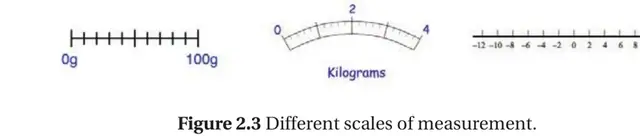
Scale: a set of numbers, amounts, etc., used to measure or compare the level of something.
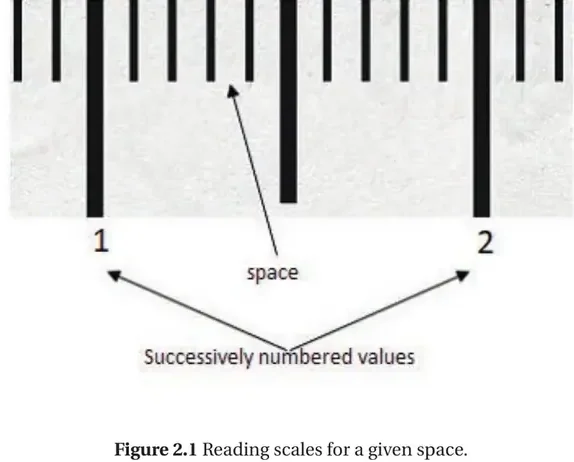
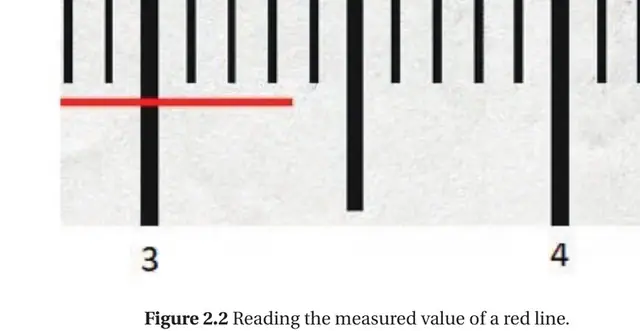
- The marks on a scale show a certain amount of whatever is measured.
- More marks on a device means a more precise device.
- Read the last digit by estimating between two marks.
- Digital instruments show the number with its unit, which is easy to read and accurate.
- There are four types of scales: nominal, ordinal, interval and ratio. Most physics scales are ratio scales.
- What is your mass in kilograms?
- Which traditional and common scales and units do people use for length, mass, time, volume and temperature?
Standard unit: a conventional unit used to measure a physical quantity scientifically.
- A standard must be readily accessible and have a property that can be measured reliably.
- Measurements by different people in different places must give the same result.
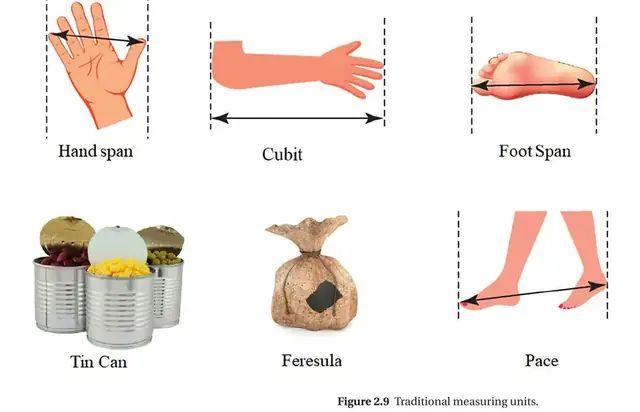
- Traditional units (a palm for cotton, footsteps for length) have no standard. They cause inaccuracy and bias.
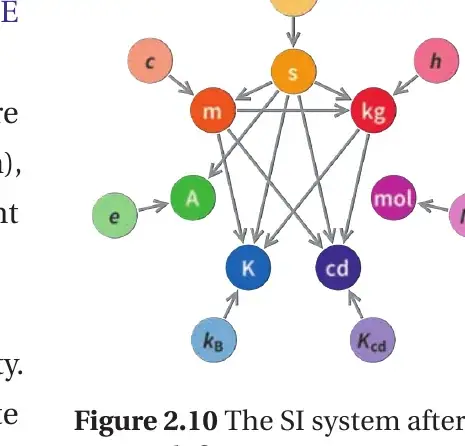
- In 2019 an International Committee revised the standards for the basic quantities.
- The system is called the SI system of units, an adaptation of the metric system.
- It has seven basic quantities: length, mass, time, temperature, current, amount of substance and luminous intensity.
Read the full notes for all 4 sections, worked examples and figures, plus 8 exercises with step-by-step solutions, the Short Note and the unit review.
📑 Contents
- 2.1Scales, Standards, Units (prefixes)Preview
- 2.2Measurement and Safety🔒
- 2.3Classification of Physical Quantities🔒
- 2.4Unit Conversion🔒
✍️ Practice questions
5 questions from the Unit 2 quiz. Choose an answer, then check it.
- 1
In physics, a "scale" is best described as:
- AA set of numbers, amounts, or marks used to measure or compare the level of something
- BA branch of physics
- CA type of vector
- DA device used only to measure weight
Show answer
A A set of numbers, amounts, or marks used to measure or compare the level of something
- 2
Finer markings on a measuring scale generally allow for:
- ANo change in precision
- BOnly qualitative measurements
- CLess precise measurements
- DMore precise measurements
Show answer
D More precise measurements
- 3
The 2019 redefinition of the SI system fixed the meter, second, and kilogram to:
- ALocal national standards only
- BA single physical object kept in France
- CUniversal physical constants
- DRandom arbitrary values
Show answer
C Universal physical constants
- 4
Which of the following is the SI (International System) base unit of length?
- AMeter
- BCentimeter
- CInch
- DFoot
Show answer
A Meter
- 5
Which of the following is the SI base unit of mass?
- AOunce
- BGram
- CPound
- DKilogram
Show answer
D Kilogram