
Simple Machines
- People use an axe to split wood, a knife to cut, and a pulley to lift water from a well.
- These are simple machines: they help us do work more easily.
- Know the types of simple machines.
- Define mechanical advantage, velocity ratio and efficiency of a machine.
- Solve problems related to simple machines.
- Construct simple machines that solve real problems in the local area.
Simple machine: a device that requires a single force to do mechanical work, making the work easier.
A simple machine makes work easier by:
- Changing the direction of the force: pulling down on a rope over a pulley raises a flag.
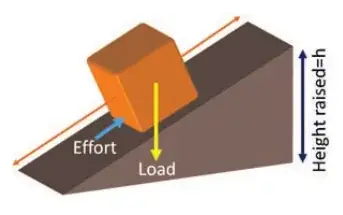
- Changing the distance of the effort (multiplying speed or distance): a ramp makes the box travel a longer distance.
- Changing the strength of the force (multiplying force): a bottle opener turns a weak force over a long distance into a strong force over a short distance.
Effort (F): the force exerted on a machine by an external body, such as a person.
Load (L): the force exerted by the machine on the object to be lifted or moved.
- Work input = effort × distance moved by the effort (5.1).
- Work output = load × distance moved by the load (5.2).
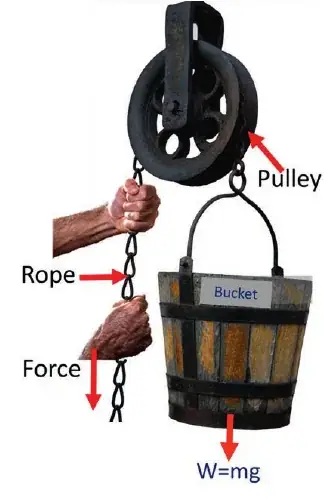
- Fixed pulley: the effort and the load move the same distance in the same time, so its purpose is to change direction.
- Inclined plane: a small effort lifts a heavy load, so it is a force multiplier.
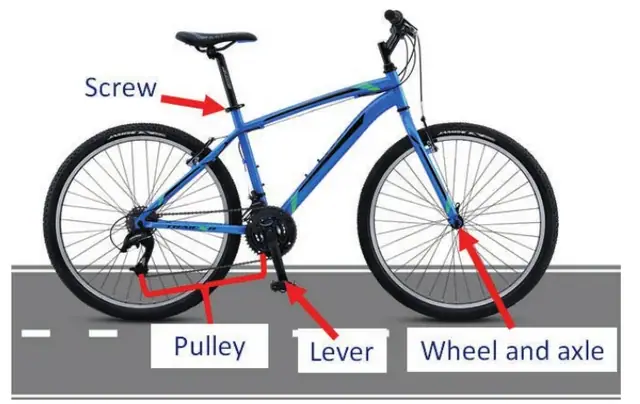
- Bicycle: a small pedal movement gives a long distance, so it is a speed (distance) multiplier.
Read the full notes for all 6 sections, worked examples and figures, plus 6 exercises with step-by-step solutions, the Short Note and the unit review.
📑 Contents
- 5.1Simple Machines and their PurposesPreview
- 5.2Simple Machines at Home🔒
- 5.3Simple Machines at Work Place🔒
- 5.4Classification of Simple Machines🔒
- 5.5Mechanical Advantage, Velocity Ratio and Efficiency🔒
- 5.6Designing Simple Machine🔒
✍️ Practice questions
5 questions from the Unit 5 quiz. Choose an answer, then check it.
- 1
A simple machine is best defined as any device that helps us do work more easily by:
- AReducing energy input to zero
- BUsing a single applied force
- CIncreasing friction only
- DEliminating the need for force entirely
Show answer
B Using a single applied force
- 2
In a simple machine, the force applied by the user is called the:
- AFulcrum
- BLoad
- CEffort
- DOutput
Show answer
C Effort
- 3
In a simple machine, the resistance or weight to be overcome is called the:
- AInput
- BEffort
- CFulcrum
- DLoad
Show answer
D Load
- 4
A machine that allows us to lift a large load using a small effort is described as a:
- AForce multiplier
- BEnergy destroyer
- CDistance multiplier
- DFriction multiplier
Show answer
A Force multiplier
- 5
A machine that allows the load to move a large distance while the effort moves only a small distance is described as a:
- AFriction reducer
- BDistance multiplier
- CEnergy multiplier
- DForce multiplier
Show answer
B Distance multiplier