
Mechanical Oscillation and Sound Wave
- A swing, a pendulum clock, a vibrating guitar string and the sound of a kirar all involve motion that repeats again and again.
- This repeated motion is called oscillation, and the disturbance it sends out through a medium is a wave.
- Describe the characteristics of waves and use f = 1/T and v = λf.
- Describe the motion of a simple pendulum and of a mass on a spring, and calculate their periods.
- Distinguish mechanical from electromagnetic waves, and transverse from longitudinal waves.
- Explain how sound is produced and travels, and describe echo, refraction and diffraction of sound.
- Explain the superposition of waves and standing waves.
- Describe pitch, loudness and timbre, and the effects of sound pollution.
Wave: a disturbance that travels (propagates) from a source and carries energy.
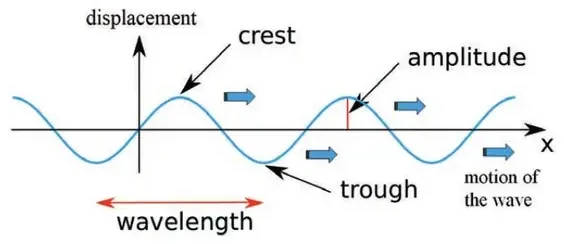
| Term | Meaning | Unit |
|---|---|---|
| Rest position | The position of a particle when there is no wave | m |
| Displacement | Distance of a particle from its rest position | m |
| Crest / trough | Highest / lowest point of the wave | m |
| Amplitude (A) | Maximum displacement from the rest position | m |
| Wavelength (λ) | Distance between two successive crests (or troughs) | m |
| Period (T) | Time taken for one complete cycle | s |
| Frequency (f) | Number of cycles in one second | Hz (1/s) |
| Wave speed (v) | Distance travelled by the wave per unit time | m/s |
A wave has a frequency of 2 Hz. Its period is . If its wavelength is 3 m, its speed is v = λf = 3 × 2 = 6 m/s.
Read the full notes for all 6 sections, worked examples and figures, plus 5 exercises with step-by-step solutions, the Short Note and the unit review.
📑 Contents
- 6.1Common Characteristics of WavesPreview
- 6.2Waves on a String, Pendulum and Spring🔒
- 6.3Propagation of Waves🔒
- 6.4Sound Waves🔒
- 6.5Superposition of Waves🔒
- 6.6Characteristics of Sound Waves🔒
✍️ Practice questions
5 questions from the Unit 6 quiz. Choose an answer, then check it.
- 1
The maximum displacement of a wave from its equilibrium (rest) position is called the:
- APeriod
- BWavelength
- CFrequency
- DAmplitude
Show answer
D Amplitude
- 2
The distance between identical points on adjacent waves (e.g., crest to crest) is called the:
- APeriod
- BFrequency
- CWavelength
- DAmplitude
Show answer
C Wavelength
- 3
The number of complete wave cycles occurring per second is called the:
- AAmplitude
- BFrequency
- CPeriod
- DWavelength
Show answer
B Frequency
- 4
The time taken to complete one full wave cycle is called the:
- APeriod
- BAmplitude
- CWavelength
- DFrequency
Show answer
A Period
- 5
Frequency and period are related by the formula:
- Af = T²
- Bf = 1/T
- Cf = T
- Df = T + 1
Show answer
B f = 1/T