
Force, Work, Energy and Power
- Unit 3 described motion (kinematics).
- This unit asks what causes motion: forces.
- The study of motion together with its causes is called dynamics.
- A force is a push or a pull.
- We study the types of forces, Newton's laws of motion, friction, and the concepts of work, energy and power.
- Understand the different types of forces.
- Practically measure forces and differentiate between mass and weight.
- Explain Newton's laws of motion.
- Know about work and energy.
- Relate work and power.
Force: a push or a pull exerted on a body that changes the state of motion of the body (its velocity) or deforms it (changes its shape or size).
- Force is a vector quantity: it has magnitude and direction. It is written as F⃗ or bold F and drawn as an arrow.
- SI unit: newton (N).
- Examples: friction, normal force, force of gravity, applied force.
- Contact forces: forces that need physical contact between the bodies.
- Examples: applied (push or pull), normal, friction and spring forces.
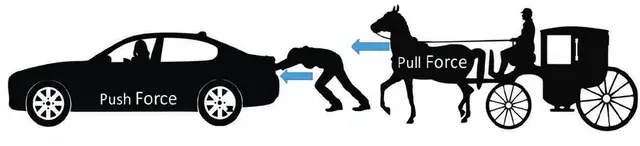
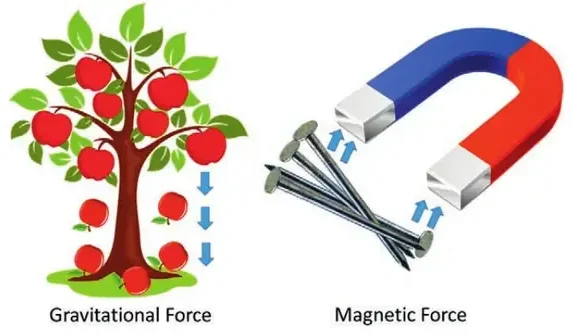
- Non-contact forces: forces that act without physical contact.
- Examples: the gravitational force of the Earth and the magnetic force of a magnet.
- The easiest way to measure force is the stretch of a spring: the pointer on the scale shows the applied force.
- Weight is the magnitude of the gravitational force on a body. It is measured in newtons and points toward the center of the Earth.

Read the full notes for all 6 sections, worked examples and figures, plus 7 exercises with step-by-step solutions, the Short Note and the unit review.
📑 Contents
- 4.1The Concept of ForcePreview
- 4.2Newton's Laws of Motion🔒
- 4.3Forces of Friction🔒
- 4.4The Concept of Work🔒
- 4.5Kinetic and Potential Energies🔒
- 4.6Power🔒
✍️ Practice questions
5 questions from the Unit 4 quiz. Choose an answer, then check it.
- 1
Forces that involve physical contact between two bodies are called:
- AMagnetic forces only
- BGravitational forces only
- CNon-contact forces
- DContact forces
Show answer
D Contact forces
- 2
Forces that do not require physical contact between two bodies are called:
- AApplied forces only
- BNon-contact forces
- CFrictional forces only
- DContact forces
Show answer
B Non-contact forces
- 3
Which of the following is an example of a non-contact force?
- AGravitational force
- BNormal force
- CApplied force
- DFrictional force
Show answer
A Gravitational force
- 4
Weight is defined as:
- AA type of contact force only
- BThe same as mass numerically in all units
- CThe magnitude of the gravitational force acting on a body
- DThe mass of an object
Show answer
C The magnitude of the gravitational force acting on a body
- 5
Newton's First Law states that an object at rest remains at rest, and an object in motion continues moving at constant velocity, unless acted upon by:
- AGravity only
- BA net external force
- CIts own mass
- DFriction only
Show answer
B A net external force