
Unit 2
Computer Network
Unit Overview
- In Grades 7 and 8 you learned about the Internet and its services: web surfing, file sharing, chatting, messaging and social media.
- This unit presents the fundamental concepts of the computer network on which those services depend.
- It defines a network, describes its hardware and software components, presents the types of network, and weighs the advantages of connecting computers and other devices against the potential threats.
🎯 Learning Outcomes
- Define what a computer network is.
- Identify the building blocks of a computer network.
- Compare and contrast the basic types of networks (LAN, MAN, WAN) and client-server versus peer-to-peer.
- Describe the topologies of networks.
- Discuss the advantages and disadvantages of networks.
- Draw simple network diagrams using network device symbols.
2.1 Definition of Network
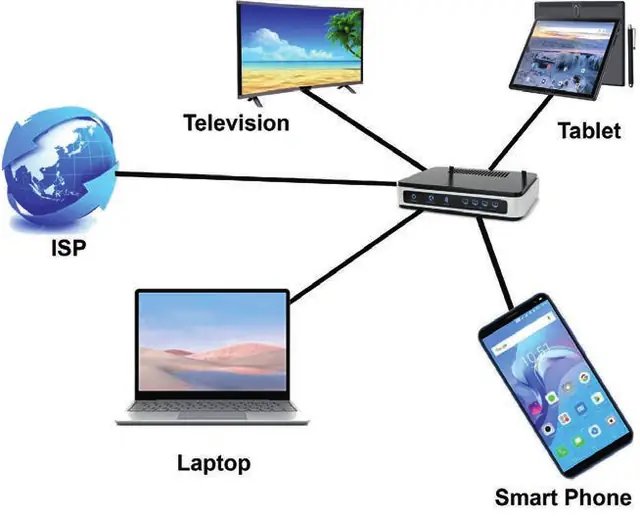
- A network is a connection of two or more computers that are linked together in order to share resources, such as printers, files and disks, or to allow electronic communication.
- Using Bluetooth on a mobile phone to share files is an example of a network.
- The Internet is sometimes called the largest global network.
✏️ Activity 2.1
1. What is a computer network?
2. What are the applications of networks in our day-to-day lives?
🔒
The rest of Unit 2 is in the Danulearn app
Read the full notes for all 4 sections, worked examples and figures, plus 6 exercises with step-by-step solutions, the Short Note and the unit review.
📑 Contents
- 2.1Definition of NetworkPreview
- 2.2Fundamental Elements of Network🔒
- 2.3Types of Networks🔒
- 2.4Advantages and Disadvantages of Network🔒