
Unit 6
Electromagnetic Waves and Geometrical Optics
Introduction
- Light is one form of electromagnetic wave.
- Light lets us see things and is responsible for our visual contact with our immediate environment; it enables us to admire the beautiful manifestations of nature.
- Light rays can be used to model mirrors, lenses, telescopes, microscopes and prisms.
- The study of how light interacts with materials is called optics.
- When dealing with light rays we are usually interested in the shape of a material and the angles at which the rays hit it; this kind of optics is called geometrical optics.
- This unit deals with electromagnetic waves, the laws of reflection and refraction, mirrors and lenses, the human eye and optical instruments, and the colours of light.
🎯 Learning Outcomes
- Understand the concept of electromagnetic waves.
- Understand the properties and transmission of light in various media and their applications.
- Investigate the properties of light through experiment and illustrate them with diagrams and optical instruments.
- Predict the behaviour of light using ray diagrams.
- Appreciate the contributions of optics to day-to-day life.
6.1 Electromagnetic (EM) Waves
- A wave transfers energy from one place to another without transferring matter.
- Waves such as water waves and sound waves transfer energy by making particles of matter move; the energy is passed from particle to particle as they collide with their neighbours.
- Depending on their medium of propagation, waves are of two kinds: mechanical waves and electromagnetic (EM) waves.
- Mechanical waves use matter to transfer energy. They cannot travel in the almost empty space between the Earth and the Sun.
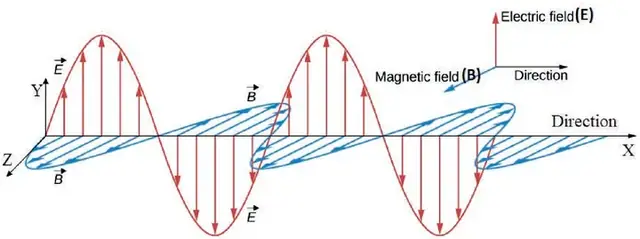
- An EM wave can travel through empty space or through matter. EM waves are produced by charged particles, such as electrons, that move back and forth or vibrate; the wave is made of electric and magnetic fields.
- Both fields vibrate at right angles to the direction of wave motion, so EM waves are transverse waves. In a transverse wave the direction of oscillation is perpendicular to the direction of propagation (a wave on a rope); in a longitudinal wave it is parallel to the direction of propagation (sound).
- Like all waves, an EM wave has a frequency (the number of times the electric and magnetic parts vibrate each second) and a wavelength (the distance between successive crests or troughs of the vibrating fields).
6.1.1Radiant Energy from the Sun
- The Sun emits EM waves that travel through space and reach the Earth. The energy carried by EM waves is called radiant energy.
- Almost 92 % of the radiant energy reaching the Earth from the Sun is carried by infrared and visible light waves. Infrared waves make you feel warm in sunlight; visible light enables you to see.
- A small amount of the radiant energy is carried by ultraviolet waves; these cause sunburn if you are exposed to sunlight for too long.
🔒
The rest of Unit 6 is in the Danulearn app
Read the full notes for all 9 sections, worked examples and figures, plus 17 exercises with step-by-step solutions, the Short Note and the unit review.
📑 Contents
- 6.1Electromagnetic (EM) WavesPreview
- 6.2The EM Spectrum🔒
- 6.3Light as a Wave🔒
- 6.4Laws of Reflection and Refraction🔒
- 6.5Mirrors and Lenses🔒
- 6.6The Human Eye and Optical Instruments🔒
- 6.7Primary Colours of Light and Human Vision🔒
- 6.8Colour Addition of Light🔒
- 6.9Colour Subtraction of Light Using Filters🔒
✍️ Practice questions
5 questions from the Unit 6 quiz. Choose an answer, then check it.
- 1
Electromagnetic waves are produced by the oscillation of:
- AWater molecules
- BMechanical springs
- CElectric and magnetic fields
- DSound particles only
Show answer
C Electric and magnetic fields
- 2
Unlike mechanical (sound) waves, electromagnetic waves can travel through:
- AA vacuum (empty space)
- BNothing at all
- COnly liquids
- DOnly solids
Show answer
A A vacuum (empty space)
- 3
All electromagnetic waves travel through a vacuum at the same:
- AFrequency
- BWavelength
- CAmplitude
- DSpeed (the speed of light)
Show answer
D Speed (the speed of light)
- 4
Arranging electromagnetic waves in order of increasing frequency (or decreasing wavelength) gives the:
- AVisible spectrum only
- BElectromagnetic spectrum
- CSound spectrum
- DColor spectrum only
Show answer
B Electromagnetic spectrum
- 5
In the electromagnetic spectrum, which type of wave has the lowest frequency and lowest energy?
- AUltraviolet rays
- BRadio waves
- CX-rays
- DGamma rays
Show answer
B Radio waves