
Unit 2
Uniformly Accelerated Motion
Introduction
- In Grade 9 you learnt that uniform motion occurs when an object moves at a steady speed in a straight line.
- Most moving objects, however, do not display uniform motion.
- Any change in an object's speed, or direction, or both, makes its motion non-uniform.
- This non-uniform motion, or changing velocity, is called accelerated motion.
- A car ride in a city at rush hour, during which the car must speed up, slow down and turn corners, is an obvious example of accelerated motion.
- In this unit you will learn about uniformly accelerated motion: motion in a straight line in which the velocity changes by equal amounts in equal times.
🎯 Learning Outcomes
- Know the terms used to describe uniformly accelerated motion.
- Understand the different types of motion used to describe physical phenomena.
- Know the equations of motion that describe the motion of an object under uniform acceleration.
- Solve motion problems using the uniformly accelerated motion formulas.
- Understand relative velocity in one dimension.
2.1 Position and Displacement
2.1.1Position
- To describe the motion of an object you must first be able to describe its position, that is, where it is at any particular time.
- Saying that you are "here" is meaningless; you have to specify your position relative to a known reference point.
- A frame of reference is an arbitrary set of axes from which the position and motion of an object are described.
- For objects moving in a straight line, imagine the object on a number line. It may be at any point, in the positive numbers or the negative numbers.
- It is common to choose the original position of the object as the zero mark. By making the zero mark the reference point you have chosen a frame of reference.
- The exact position of an object is the separation between the object and the reference point.
- Position: the location of an object with reference to an origin.
- It can be negative or positive, and it has units of length: centimetre (cm), metre (m) or kilometre (km).
- For example, you can say that the newly constructed school is 300 m from Kemal's house, with Kemal's house as the reference point (origin).
Remember: The location of an object in a frame of reference is called its position.
2.1.2Distance and Displacement
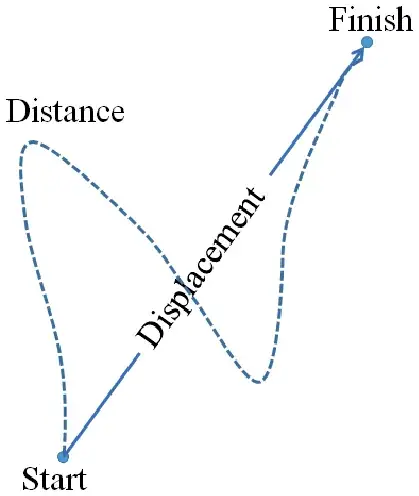
- Distance: the total length of the path taken in going from the initial position to the final position.
- Distance is a scalar.
- Displacement: the difference between the initial and final position vectors of a body.
- It is the shortest distance between the two positions and has a definite direction, so displacement is a vector quantity.
- In Figure 2.1 the distance is the length of the dashed line, while the displacement is the straight-line distance from the starting point to the end point.
🔒
The rest of Unit 2 is in the Danulearn app
Read the full notes for all 6 sections, worked examples and figures, plus 10 exercises with step-by-step solutions, the Short Note and the unit review.
📑 Contents
- 2.1Position and DisplacementPreview
- 2.2Average Velocity and Instantaneous Velocity🔒
- 2.3Acceleration🔒
- 2.4Equations of Motion with Constant Acceleration🔒
- 2.5Graphical Representation of Uniformly Accelerated Motion🔒
- 2.6Relative Velocity in One Dimension🔒
✍️ Practice questions
5 questions from the Unit 2 quiz. Choose an answer, then check it.
- 1
The shortest straight-line distance between an object's initial and final position, along with direction, is called:
- ADistance
- BSpeed
- CPosition
- DDisplacement
Show answer
D Displacement
- 2
Which of the following is a scalar quantity related to motion?
- AAcceleration
- BDistance
- CVelocity
- DDisplacement
Show answer
B Distance
- 3
The rate of change of displacement with respect to time is called:
- AVelocity
- BDistance
- CSpeed
- DAcceleration
Show answer
A Velocity
- 4
Average velocity is calculated as:
- AChange in acceleration ÷ time
- BTotal distance ÷ total time
- CTotal displacement ÷ total time
- DFinal velocity − initial velocity
Show answer
C Total displacement ÷ total time
- 5
The velocity of an object at a particular moment in time is called its:
- ARelative velocity
- BAverage velocity
- CInstantaneous velocity
- DUniform velocity
Show answer
C Instantaneous velocity