
Unit 5
Magnetism
Introduction
- Magnetism is an interaction that allows certain kinds of objects, called magnets, to exert forces on each other without physically touching.
- Humans have known about magnetism for thousands of years: lodestone, a magnetised form of the iron-oxide mineral magnetite, has the property of attracting iron objects.
- Today magnetism plays many important roles in our lives, from the compass and the refrigerator door to electric motors, generators, loudspeakers, hard disks and MRI scanners.
- In this unit you will learn the fundamental concepts of magnets, magnetic fields and magnetic forces, together with some simple applications.
🎯 Learning Outcomes
- Understand the nature and characteristics of magnets.
- Understand what is meant by a magnetic field.
- Understand the concepts related to magnetic force.
- Solve problems related to magnetism.
- Appreciate simple applications of magnetism in everyday life.
5.1 Magnet
- The use of magnets was discovered by the ancient Greeks, who found stones able to attract iron and nickel; this naturally occurring stone is called lodestone.
- Magnet: a material or object that produces a magnetic field, which is responsible for a force that pulls (attracts) other materials.
- Magnets attract objects made of iron or steel, such as nails and paper clips, and can attract or repel other magnets.
- Magnets are made in various shapes (bar, horseshoe, ring, cylindrical, arc and square magnets, Figure 5.1) and create their own persistent magnetic field.
- They are used in appliances such as tape recorders, radios, motors, door bells and headphones to hold, separate, control or lift substances, converting electrical energy into mechanical energy (motors, loudspeakers) or mechanical energy into electrical energy (generators, microphones).
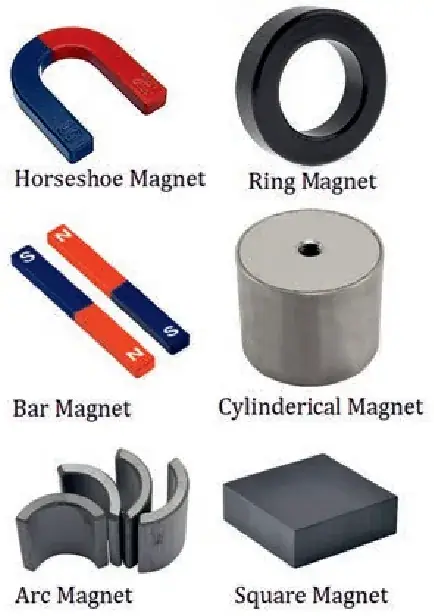
5.1.1Types of Magnets
- Permanent magnets are made of magnetic material (such as steel) that has been magnetised and keeps its own magnetic field. They do not lose their magnetism once magnetised, although their strength depends on the material. They are used in speakers, mobile phones, cars, generators, televisions and sensors.
- A permanent magnet can be demagnetised by exposing it to extreme temperatures, by hammering it (the alignment of its atoms is loosened) or by striking one magnet against another in the wrong way.
- Temporary magnets are magnetised only in the presence of a magnetic field and lose their magnetism when the field is removed. Iron nails and paper clips are examples.
🔒
The rest of Unit 5 is in the Danulearn app
Read the full notes for all 8 sections, worked examples and figures, plus 9 exercises with step-by-step solutions, the Short Note and the unit review.
📑 Contents
- 5.1MagnetPreview
- 5.2Magnetic Field🔒
- 5.3The Earth's Magnetic Field and the Compass🔒
- 5.4Magnetic Field of a Current-Carrying Conductor🔒
- 5.5Magnetic Force on a Moving Charge in a Uniform Magnetic Field🔒
- 5.6Magnetic Force on a Current-Carrying Wire🔒
- 5.7Magnetic Force between Two Parallel Current-Carrying Wires🔒
- 5.8Applications of Magnetism🔒
✍️ Practice questions
5 questions from the Unit 5 quiz. Choose an answer, then check it.
- 1
A material that attracts iron and other magnetic materials and has two distinct poles is called a:
- ACapacitor
- BInsulator
- CMagnet
- DConductor
Show answer
C Magnet
- 2
Every magnet has how many poles?
- AOne
- BFour
- CThree
- DTwo (north and south)
Show answer
D Two (north and south)
- 3
Like magnetic poles (e.g., north-north) will:
- ARepel each other
- BFuse together
- CHave no interaction
- DAttract each other
Show answer
A Repel each other
- 4
Unlike magnetic poles (north-south) will:
- AAlways cancel out
- BAttract each other
- CRepel each other
- DHave no interaction
Show answer
B Attract each other
- 5
The region around a magnet where magnetic forces can be detected is called the:
- AElectric field
- BCurrent loop
- CGravitational field
- DMagnetic field
Show answer
D Magnetic field