
Elasticity and Static Equilibrium of Rigid Body
- In Grade 9 you studied the effect of a force on a body in producing displacement.
- The force applied to an object may also change its shape or size.
- Some objects regain their original shape and size when the force is removed, whereas others do not.
- This behaviour depends on the microscopic structure of the material and is described by two properties: elasticity and plasticity.
In this unit you will learn about elasticity, plasticity, density and specific gravity, stress and strain, the Young modulus, and the two conditions for the static equilibrium of a rigid body, which engineers use when they design bridges, ladders, cranes and buildings.
- Understand the differences between elasticity and plasticity of an object.
- Describe density and specific gravity and determine them for an object.
- Comprehend the concepts of stress and strain.
- Know that the Young modulus is the ratio of stress to strain of an object.
- Understand the physical conditions of static equilibrium.
- Apply the conditions of equilibrium to a body in static equilibrium in everyday activity.
- A rigid body generally means a hard solid object having a definite shape and size.
- In reality, however, all bodies can be stretched, compressed and bent.
- Even an appreciably rigid steel bar can be deformed when a sufficiently large external force is applied to it, as you may have seen with iron rods at construction sites.
- No practical solid body is perfectly rigid.
- Deforming force: the force required to change (deform) the shape or size of a body.
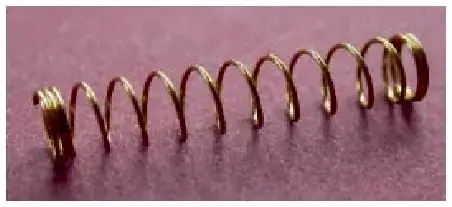
- If you stretch the helical spring of Figure 3.1 by gently pulling its ends, its length increases slightly; when you release the ends it regains its original size and shape.
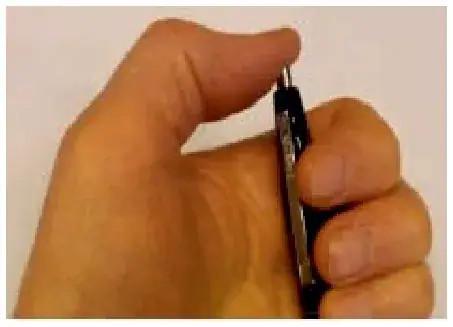
- In a click pen, pressing the cap pushes the writing point out of the casing; pressing again sends it back. Two points to note: the spring inside gets deformed on pushing the cap, and it regains its original shape once the deforming force is removed.
- Elasticity: if a body regains its original shape and size after the removal of the deforming force, it is said to be elastic, and the property is called elasticity.
- The deformation caused is an elastic deformation.
- Examples: rubber, metals, steel ropes.
- Plasticity: if a body does not regain its original shape and size after removal of the deforming force, it is a plastic body and the property is called plasticity.
- A lump of putty or potter's clay has no tendency to regain its previous shape; it is permanently deformed.
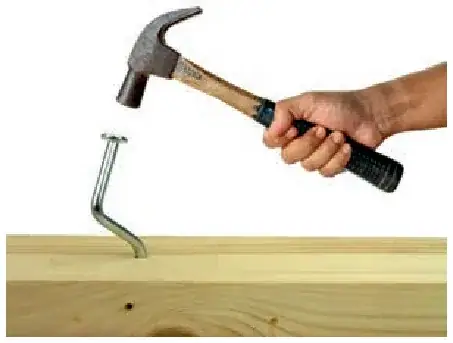
- The nail in Figure 3.3 bent by a hammer blow shows a permanent deformation.
- Plasticity is the ability to be permanently formed or moulded. It is vital in the manufacture of goods by heat or pressure treatment and by moulding.
Read the full notes for all 5 sections, worked examples and figures, plus 6 exercises with step-by-step solutions, the Short Note and the unit review.
📑 Contents
- 3.1Elasticity and PlasticityPreview
- 3.2Density and Specific Gravity🔒
- 3.3Stress and Strain🔒
- 3.4The Young Modulus🔒
- 3.5Static Equilibrium🔒
✍️ Practice questions
5 questions from the Unit 3 quiz. Choose an answer, then check it.
- 1
The property of a material that allows it to return to its original shape after a deforming force is removed is called:
- APlasticity
- BDensity
- CStress
- DElasticity
Show answer
D Elasticity
- 2
The property of a material that causes it to remain permanently deformed after a force is removed is called:
- APlasticity
- BStiffness
- CRigidity
- DElasticity
Show answer
A Plasticity
- 3
Density is defined as:
- AWeight per unit area
- BMass per unit volume
- CMass × volume
- DVolume per unit mass
Show answer
B Mass per unit volume
- 4
Specific gravity of a substance is defined as the ratio of its density to the density of:
- AMercury
- BIron
- CWater
- DAir
Show answer
C Water
- 5
The internal restoring force per unit cross-sectional area developed in a material under an applied load is called:
- AStrain
- BModulus
- CElasticity
- DStress
Show answer
D Stress