
Coordinate Geometry
- Coordinate geometry connects algebra and geometry through graphs of lines and curves, so geometric problems can be solved algebraically.
- The Cartesian plane is divided into four quadrants by the perpendicular x-axis (horizontal) and y-axis (vertical), which meet at the origin (0, 0).
- The position of any point is given by an ordered pair (x, y), its coordinates: x is the abscissa and y the ordinate.
- Once the coordinates of two points are known, the distance between them and the midpoint of the segment joining them can be found.
- Find the distance between any two given points in the coordinate plane.
- Divide a given line segment into different ratios.
- Describe the equation of a line in different forms.
- Describe the equation of a circle in different forms.
- Relate the slope of parallel and perpendicular lines.
- Distance is always positive, or zero if the points coincide, and the distance from A to B equals the distance from B to A.
- For horizontally aligned points the distance is d = |x₂ − x₁|, and for vertically aligned points d = |y₂ − y₁|.
- For example A(1, 2) and B(4, 2) are 3 units apart, and P(1, −2) and Q(1, 3) are 5 units apart.
Find the distance between the following points.
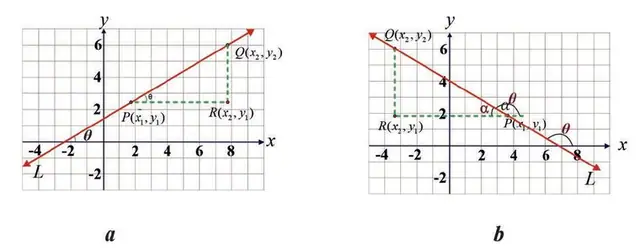
- When the segment is neither horizontal nor vertical, draw the right-angled triangle PRQ with R(x₂, y₁); by the Pythagoras theorem PQ² = PR² + RQ².
- Definition 7.1: if P(x₁, y₁) and Q(x₂, y₂) are the endpoints of PQ, its length is d = √((x₂ − x₁)² + (y₂ − y₁)²).
- For A(1, 2) and B(4, 6): d = √(9 + 16) = 5; for A(2, 1) and B(8, 9): d = √(36 + 64) = 10.
Read the full notes for all 6 sections, worked examples and figures, plus 13 exercises with step-by-step solutions, the Short Note and the unit review.
📑 Contents
- 7.1Distance Between Two PointsPreview
- 7.2Division of a Line Segment🔒
- 7.3Equation of a Line🔒
- 7.4Parallel and Perpendicular Lines🔒
- 7.5Equation of a Circle🔒
- 7.6Applications🔒
✍️ Practice questions
5 questions from the Unit 7 quiz. Choose an answer, then check it.
- 1
The distance between two points (x₁, y₁) and (x₂, y₂) is calculated using the formula:
- Ad = √[(x₂-x₁)² + (y₂-y₁)²]
- Bd = (x₂-x₁)(y₂-y₁)
- Cd = (x₂-x₁)² - (y₂-y₁)²
- Dd = (x₂-x₁) + (y₂-y₁)
Show answer
A d = √[(x₂-x₁)² + (y₂-y₁)²]
- 2
The distance formula is derived directly from which mathematical theorem?
- AThe Fundamental Theorem of Algebra
- BThe Pythagorean Theorem
- CThe Remainder Theorem
- DThe Factor Theorem
Show answer
B The Pythagorean Theorem
- 3
The midpoint of a line segment joining (x₁, y₁) and (x₂, y₂) is given by:
- A(x₁-x₂, y₁-y₂)
- B((x₁+x₂), (y₁+y₂))
- C(x₁×x₂, y₁×y₂)
- D((x₁+x₂)/2, (y₁+y₂)/2)
Show answer
D ((x₁+x₂)/2, (y₁+y₂)/2)
- 4
The point that divides a line segment in a given ratio internally is found using the:
- ASection (division) formula
- BSlope formula
- CDistance formula only
- DMidpoint formula only
Show answer
A Section (division) formula
- 5
The slope (gradient) of a line passing through points (x₁, y₁) and (x₂, y₂) is calculated as:
- A(y₂-y₁)/(x₂-x₁)
- B(x₂-x₁)/(y₂-y₁)
- C(x₂+x₁)/(y₂+y₁)
- D(y₂+y₁)/(x₂+x₁)
Show answer
A (y₂-y₁)/(x₂-x₁)