
Unit 5
Circles
Introduction
- You have learnt several concepts about circles in lower grades.
- In this unit you will learn more about circles: their symmetrical properties, the angle properties of circles, and the perimeters and areas of segments and sectors.
🎯 Learning Outcomes
- Explain the symmetrical properties of circles.
- Use the symmetrical properties of circles to solve related problems.
- Write angle properties of circles in their own words.
- Apply angle properties of circles to solve related problems.
- Find perimeters and areas of segments and sectors.
5.1 Symmetrical Properties of Circles
- A circle is the locus (set) of points in a plane each of which is equidistant from a fixed point in the plane.
- The fixed point is the centre and the constant distance is the radius, so a circle is determined by its centre O and radius r.
- Recall that the area of a circle is A = πr² and its perimeter (circumference) is P = 2πr.
- A line of symmetry divides a figure into two halves that match exactly when folded along the line; corresponding lengths and angles in the two halves are equal.
- If P and Q are corresponding points for a line of symmetry AB, then AB is the perpendicular bisector of PQ.
- If we fold a circle along any diameter the two halves match, so every diameter is a line of symmetry: a circle has infinitely many lines of symmetry.
- A circle inscribed in a square, however, has only the 4 lines of symmetry of the square.
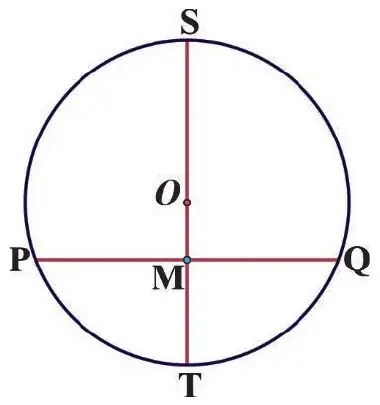
- Theorem 5.1: The line segment joining the centre of a circle to the midpoint of a chord is perpendicular to the chord.
- (Draw the diameter ST through the midpoint M of PQ; the circle is symmetric about ST and PM = QM, so ST is the perpendicular bisector of PQ and ∠OMP is a right angle.)
🔒
The rest of Unit 5 is in the Danulearn app
Read the full notes for all 4 sections, worked examples and figures, plus 11 exercises with step-by-step solutions, the Short Note and the unit review.
📑 Contents
- 5.1Symmetrical Properties of CirclesPreview
- 5.2Angle Properties of Circles🔒
- 5.3Arc Lengths, Perimeters and Areas of Segments and Sectors🔒
- 5.4Theorems on Angles and Arcs Determined by Lines Intersecting inside, on and outside a Circle🔒
✍️ Practice questions
5 questions from the Unit 5 quiz. Choose an answer, then check it.
- 1
A line segment from the center of a circle to any point on the circle is called a:
- ATangent
- BChord
- CDiameter
- DRadius
Show answer
D Radius
- 2
A line segment joining two points on a circle is called a:
- AChord
- BSector
- CArc
- DRadius
Show answer
A Chord
- 3
A chord that passes through the center of a circle is called a:
- ATangent
- BSecant
- CDiameter
- DRadius
Show answer
C Diameter
- 4
A line that touches a circle at exactly one point is called a:
- AChord
- BSecant
- CTangent
- DDiameter
Show answer
C Tangent
- 5
A line that intersects a circle at exactly two points is called a:
- ATangent
- BSecant
- CArc
- DRadius
Show answer
B Secant