
Unit 4
Trigonometric Functions
Introduction
- The word ‘trigonometry’ comes from the Greek words ‘trigon’ and ‘metron’ and means ‘measuring the sides of a triangle’.
- It was first developed to solve geometric problems involving triangles and was used by sea captains for navigation, surveyors for mapping new lands and engineers.
- Today trigonometry is used in seismology, electric circuits, describing the state of an atom, predicting the heights of tides and analysing musical tones.
- In Grade 9 you studied the trigonometric ratios of acute angles as ratios of the sides of a right-angled triangle.
- In this unit you generalize these ratios to trigonometric functions of any angle, study their graphs and properties, learn the basic identities, solve simple trigonometric equations and apply them to real-life problems.
🎯 Learning Outcomes
- Define the basic trigonometric functions.
- Sketch graphs of basic trigonometric functions.
- Define reciprocals of basic trigonometric functions.
- Identify trigonometric identities.
- Solve some real-life problems involving trigonometric equations.
- Conceptualize theorems on special triangles.
4.1 Radian Measure of Angle
Angles
- An angle is a measure of the rotation of a ray about its initial point.
- The original ray is the initial side, the final position of the ray is the terminal side, and the point of rotation is the vertex.
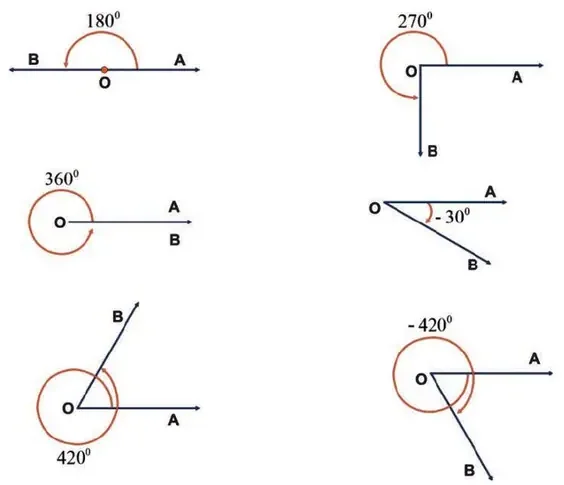
- If the rotation is anticlockwise the angle is positive; if it is clockwise the angle is a negative angle.
- One complete revolution brings the terminal side back onto the initial side.
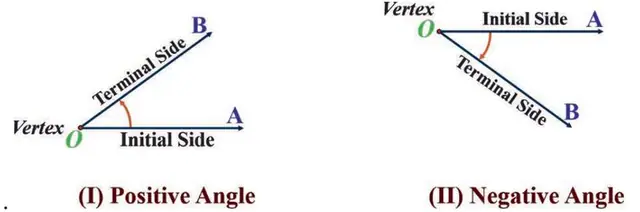
- An angle in the coordinate plane is in standard position if its vertex is at the origin and its initial side lies on the positive x-axis.
- An angle in standard position whose terminal side lies on an axis (0°, 90°, 180°, 270°, …) is a quadrantal angle.
- To put a large angle in standard position, write it as a whole number of revolutions plus an angle between 0° and 360°: 200° = 180° + 20°, 1125° = 3 × 360° + 45°, −900° = 2 × (−360°) + (−180°).
4.1.1Degree measure
- If the rotation from the initial side to the terminal side is of a complete revolution, the angle has a measure of one degree, written 1°.
- A degree is divided into 60 minutes (1° = 60′) and a minute into 60 seconds (1′ = 60″).
🔒
The rest of Unit 4 is in the Danulearn app
Read the full notes for all 4 sections, worked examples and figures, plus 24 exercises with step-by-step solutions, the Short Note and the unit review.
📑 Contents
- 4.1Radian Measure of AnglePreview
- 4.2Basic Trigonometric Functions🔒
- 4.3Trigonometric Identities and Equations🔒
- 4.4Applications of Trigonometric Functions🔒
✍️ Practice questions
5 questions from the Unit 4 quiz. Choose an answer, then check it.
- 1
One full revolution (360°) is equivalent to how many radians?
- Aπ/2 radians
- B2π radians
- C4π radians
- Dπ radians
Show answer
B 2π radians
- 2
To convert an angle from degrees to radians, you multiply the degree measure by:
- Aπ/180
- B360/π
- C180/π
- Dπ
Show answer
A π/180
- 3
To convert an angle from radians to degrees, you multiply the radian measure by:
- A2π
- Bπ/360
- Cπ/180
- D180/π
Show answer
D 180/π
- 4
90° expressed in radians is:
- Aπ
- B2π
- Cπ/4
- Dπ/2
Show answer
D π/2
- 5
In a right triangle, the sine of an angle is defined as the ratio of the:
- AAdjacent side to the hypotenuse
- BOpposite side to the adjacent side
- COpposite side to the hypotenuse
- DHypotenuse to the opposite side
Show answer
C Opposite side to the hypotenuse