
Banking and Finance
- One of the basic factors of production in economics is capital.
- Capital is the amount of money the producer pays for the other factors of production (labour, land and entrepreneur) used in the production process.
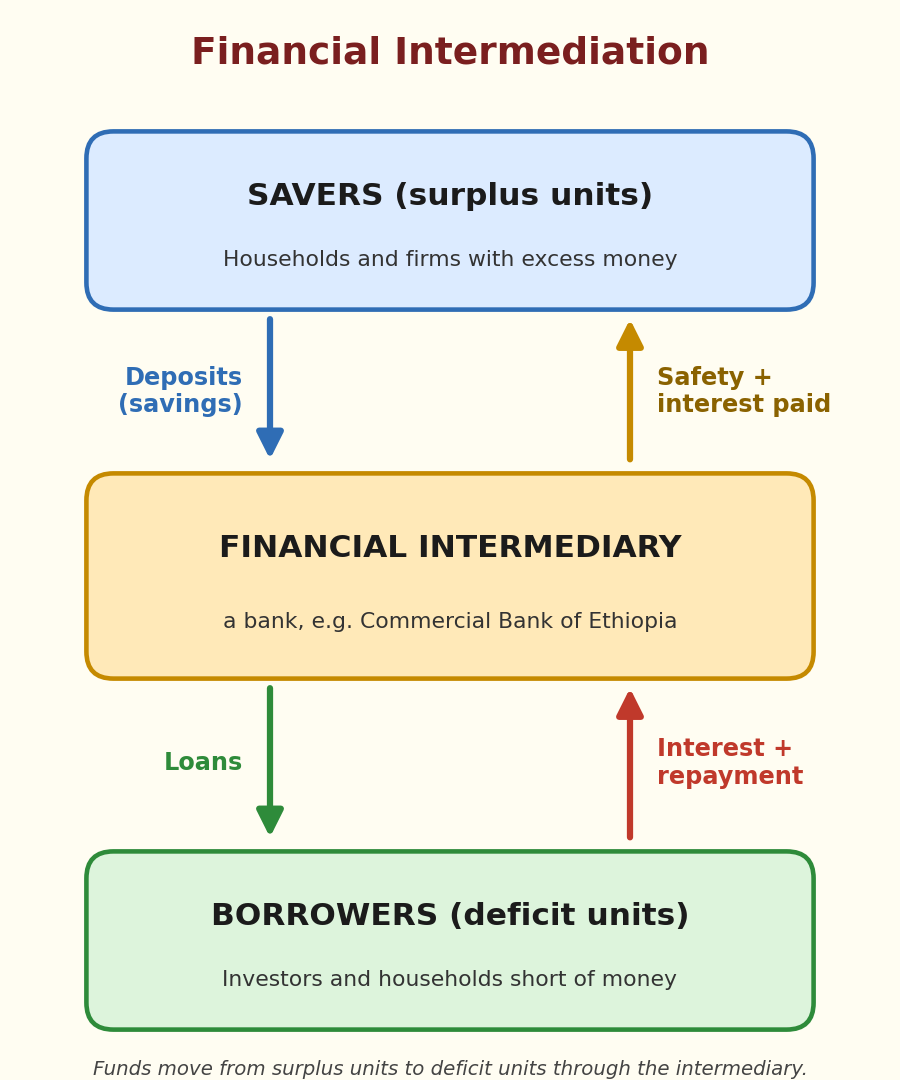
- Banks are one of the financial institutions that are used to transfer finance from those who have an excess to those that are in need of it.
- People with excess money go to a bank and put it there; this is called saving.
- People who face a shortage of money go to the bank and ask for loans.
- Banks give money as a loan according to their lending procedures.
- This activity of banks is one example of financial intermediation.
- In this unit you will study financial intermediaries, financial markets, financial institutions (banking and non-banking), the historical development of the banking sector in Ethiopia, electronic banking (e-banking), and the indigenous financial institutions in Ethiopia, “iqqub” and “iddir”.
- You are expected to think of banks and other financial intermediaries in your locality and their functions as savers of excess money and as lenders to those who need the money.
- Discuss the different types of financial intermediaries.
- Analyse the role of indigenous financial institutions.
- Explain the historical development of the financial institutions (banks, microfinances and indigenous institutions) in Ethiopia.
- Describe the financial institutions (banks, microfinances and indigenous institutions).
- Identify financial institutions in Ethiopia (banks, microfinances and indigenous institutions).
- Evaluate the roles of financial institutions for the socio-economic improvement of the society.
- Define financial intermediation.
- Mention financial intermediaries.
- List the benefits of financial intermediaries.
- Think of the financial institutions (for example, banks) in your town.
- What benefits do they bring to the people in the town?
| Group | Benefits |
|---|---|
| Depositors | Safety – the depositors’ money is free from any risk of loss. Interest earning – banks pay interest on the money saved at their banks. |
| Borrowers (investors) | Access to finance for investment when they face a shortage of money in the production process. They pay annual interest on the money they borrow. The more they borrow, the more investment (production) they undertake, which is useful for the country. |
Table: benefits of financial intermediaries to depositors and to borrowers.
Read the full notes for all 7 sections, worked examples and figures, plus 10 exercises with step-by-step solutions, the Short Note and the unit review.
📑 Contents
- 5.1Introduction to Financial IntermediariesPreview
- 5.2Introduction to Financial Markets🔒
- 5.3Introduction to Financial Institutions🔒
- 5.4Historical Development of Banks in Ethiopia🔒
- 5.5Micro-finance Institutions🔒
- 5.6Electronic Banking (e-banking)🔒
- 5.7Indigenous Financial Institutions🔒
✍️ Practice questions
5 questions from the Unit 5 quiz. Choose an answer, then check it.
- 1
A financial intermediary is best described as an entity that:
- ARegulates international trade tariffs
- BManufactures goods for export
- CSets government fiscal policy
- DActs as a middleman between savers and borrowers
Show answer
D Acts as a middleman between savers and borrowers
- 2
The transfer of funds from surplus spending units to deficit spending units through intermediaries is called:
- AFinancial intermediation
- BCapital flight
- CMonetary tightening
- DFinancial deregulation
Show answer
A Financial intermediation
- 3
For depositors, financial intermediaries mainly provide:
- AUnlimited free loans
- BSafety and interest earnings
- CHigher taxes
- DElimination of all financial risk
Show answer
B Safety and interest earnings
- 4
The money market deals in financial instruments with a maturity of:
- AExactly five years
- BNo fixed maturity
- COne year or less
- DOver ten years
Show answer
C One year or less
- 5
Treasury bills are best classified as:
- AIndigenous financial instruments
- BCapital market instruments
- CMoney market instruments
- DEquity instruments
Show answer
C Money market instruments