
Theory of Production and Cost
- In the previous unit, we discussed the theory of demand and supply.
- In this unit, we move to the theory of production and cost, which emphasises the behaviour of firms in the production of goods and services.
- Firms incur costs when they buy inputs to produce the goods and services that they plan to sell.
- In this unit, we examine the link between a firm’s production process and its total cost.
- State production and production functions in the short and long run.
- Derive and draw the various average and marginal functions from the total functions.
- Calculate the average and marginal cost and productivity values.
- Draw and explain the relationship between different types of cost curves.
- Show the relationship between production and cost curves.
- Discuss the stages of production.
- Analyse the concept of returns to scale in production.
- Define the function of production.
- Describe short run and long run production functions.
- Calculate the average and marginal products.
- State the law of diminishing marginal productivity and its implications.
- Explain the concept of returns to scale.
- Clarify the stages of production.
- Analyse technology change and the position of production curves.
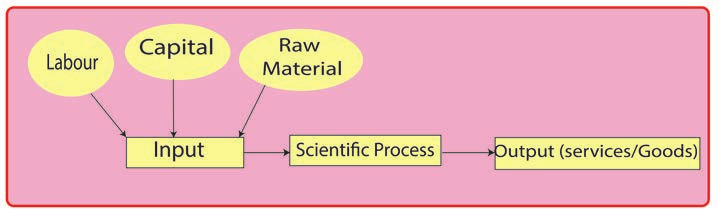
Production of goods and services involves transforming resources such as labour power, raw materials, services and machines into finished products.
- Q = f(L, K)
- The production function allows inputs to be combined in varying proportions, so output can be produced in many ways – using either more capital and less labour, or the reverse.
- Here we consider a simple production process with only two factors: we treat capital as the fixed factor and labour as the variable factor.
- Production with one variable input (while the others are fixed) is obviously a short run phenomenon.
- Consider a farmer producing wheat.
- To the farmer, the only variable input is labour, and all the other inputs, such as land, capital and technology, are fixed.
- That is, Q = F(L), with land (La), capital (K) and technology (T) held constant.
- So the short run production function tells us only the effect of a change in the farmer’s labour on the production of wheat, while the size of land, capital and technology stay constant.
Read the full notes for all 2 sections, worked examples and figures, plus 8 exercises with step-by-step solutions, the Short Note and the unit review.
📑 Contents
- 3.1Theory of ProductionPreview
- 3.2Theory of Cost🔒
✍️ Practice questions
5 questions from the Unit 3 quiz. Choose an answer, then check it.
- 1
Production is best defined as the process of:
- ASetting prices for goods and services
- BMeasuring a firm's total revenue
- CDistributing finished goods to consumers
- DTransforming inputs such as labor and capital into goods and services
Show answer
D Transforming inputs such as labor and capital into goods and services
- 2
The production function Q = f(L, K) shows:
- AThe maximum output obtainable from given combinations of inputs
- BThe minimum price a firm can charge
- CThe cost of producing a fixed level of output
- DThe relationship between wages and profit
Show answer
A The maximum output obtainable from given combinations of inputs
- 3
The short run is defined as a period in which:
- AAll inputs are variable
- BAt least one input is fixed
- CNo inputs can be changed
- DOnly capital is variable
Show answer
B At least one input is fixed
- 4
Average Product (AP) is calculated as:
- ATotal Product divided by units of variable input
- BMarginal Product divided by Total Product
- CTotal Product multiplied by price
- DChange in Total Product divided by change in capital
Show answer
A Total Product divided by units of variable input
- 5
Marginal Product (MP) is defined as:
- AThe total output from all units of labor
- BThe output level at which cost is minimized
- CThe extra output produced by one more unit of variable input
- DThe average output per unit of capital
Show answer
C The extra output produced by one more unit of variable input