
Market Structures
- In the previous unit, we discussed the theory of production and cost.
- There, we studied concepts related to a firm’s production function and cost curves.
- In this unit, we discuss the types and characteristics of firms under different market models.
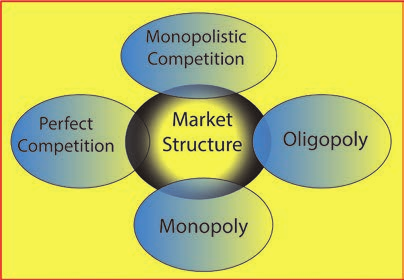
- In economics, markets are characterised based on the competition levels and the nature of their markets, such as the nature of the products, the number of sellers and the number of buyers.
- The market in which an individual firm operates or sells its product (good or service) to consumers can be categorised broadly into perfect (perfectly competitive) and imperfect markets.
- A perfectly competitive market is a market with a large number of sellers and buyers, whereas a monopoly market (dominated by one firm), an oligopoly market (very few firms) and a monopolistic competition market (relatively large numbers of firms selling closely substitutable products) are the three common types of imperfect markets.
- Explain the characteristics of the market structures.
- Analyse the nature of demand and revenue curves of a firm in each market.
- Make a list of the sources of monopoly.
- Calculate total, average, and marginal revenues.
| Market structure | Number of sellers | Product | Entry and exit | Firm’s demand curve |
|---|---|---|---|---|
| Perfect competition | Very many | Homogeneous | Free | Horizontal at the market price (price taker) |
| Pure monopoly | One | Unique, no close substitutes | Restricted (barriers) | The downward-sloping market demand curve (price maker) |
| Monopolistic competition | Many | Differentiated | Free | Downward sloping, flatter than a monopoly’s |
| Oligopoly | Few dominant firms | Homogeneous or differentiated | Restricted | Downward sloping and keeps shifting as rivals react |
Summary table: the four market structures compared.
- Define a market that is completely competitive.
- Review the characteristics of a perfectly competitive market.
- Explain the nature of demand and revenue curves in a perfectly competitive market.
- Calculate total, average, and marginal revenues.
- It is this distinction that differentiates perfectly competitive markets from imperfectly competitive ones.
- For instance, consider a farmers’ market where each seller sells the same type of product (such as maize).
- There is little differentiation between each of their products, and they each sell them at an equal price.
- At the same time, sellers and buyers are free to participate in the market without any barrier.
- Large number of buyers and sellers – the buying or selling decision of a single buyer or seller cannot affect the price of the commodity, since each firm or buyer is too small in relation to the market.
- Homogeneity of products – products supplied by the different firms are the same. For example, salt supplied by two sellers is identical to the extent that buyers cannot tell which firm supplied which product.
- Free entry and exit – there is no barrier that restricts firms’ entry into or exit out of the market. If a firm believes that it is not worth staying in business, it can go out of the market.
- Perfect information for both consumers and producers – buyers and sellers have complete knowledge of the market: product quality and nature, current and future prices, input prices and other attributes.
- Firms aim to maximise profit – firms try to increase revenue and reduce (minimise) costs so as to increase profit.
Read the full notes for all 4 sections, worked examples and figures, plus 8 exercises with step-by-step solutions, the Short Note and the unit review.
📑 Contents
- 4.1Perfectly Competitive MarketsPreview
- 4.2Pure Monopoly Market🔒
- 4.3Monopolistically Competitive Market🔒
- 4.4Oligopoly Market🔒
✍️ Practice questions
5 questions from the Unit 4 quiz. Choose an answer, then check it.
- 1
A market structure is best defined by:
- AThe number of consumers alone
- BThe government's tax policy
- CThe geographic location of a market only
- DThe number of firms, product type, and entry/exit conditions
Show answer
D The number of firms, product type, and entry/exit conditions
- 2
In a perfectly competitive market, an individual firm is best described as a:
- APrice maker
- BPrice taker
- CMonopolist
- DPrice discriminator
Show answer
B Price taker
- 3
Which of the following is a characteristic of perfect competition?
- AHomogeneous products and free entry and exit
- BA single seller controls the market
- CBarriers prevent new firms from entering
- DProducts are differentiated across firms
Show answer
A Homogeneous products and free entry and exit
- 4
The demand curve facing an individual firm in perfect competition is:
- ADownward sloping
- BPerfectly horizontal at the market price
- CUpward sloping
- DVertical
Show answer
B Perfectly horizontal at the market price
- 5
In perfect competition, the relationship between price (P), average revenue (AR), and marginal revenue (MR) is:
- AP > AR > MR
- BMR > AR > P
- CAR = 0
- DP = AR = MR
Show answer
D P = AR = MR