
Unit 8
Vectors in Two Dimensions
Introduction
- In day-to-day life you measure many physical quantities and express them with a number and a unit: a classroom 6 m by 8 m, a car’s average speed of 45 km/hr, a football field of 5,000 m², the average temperature of Dallol of 34.6 °C, a 1.5-litre bottle.
- No direction is involved in these.
- Other quantities need a direction as well as a size: a boy riding a bike at 30 km/hr in the north-east direction.
- In this unit you will learn scalar and vector quantities, how vectors are represented, adding and subtracting vectors, multiplying a vector by a scalar, and some applications.
🎯 Learning Outcomes
- Conceptualize vectors in the sense of direction and magnitude symbolically.
- Perform operations on vectors.
8.1 Vector and Scalar Quantities
- Scalars are quantities that are fully described by a magnitude (a numerical value with a unit) alone.
- Mass (a 10 kg stone), density (water is 1 g/cm³) and temperature (27 °C) are scalars.
- Vectors are quantities that are fully described by both a magnitude and a direction.
- Force, velocity, acceleration, displacement, and electric and magnetic fields are vectors.
- A force of 10 N applied vertically upward has a different effect from 10 N applied horizontally, so force is a vector.
- Distance is a scalar, but displacement is “directed distance”: 20 m from A to B.
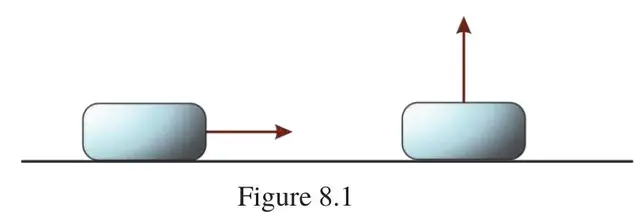
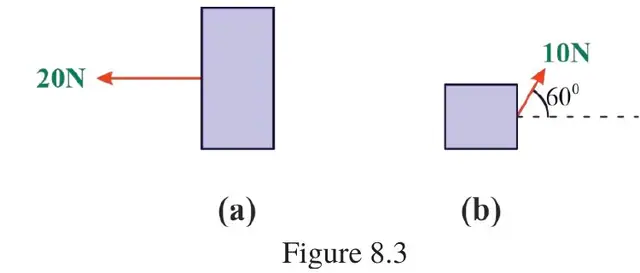
🔒
The rest of Unit 8 is in the Danulearn app
Read the full notes for all 5 sections, worked examples and figures, plus 13 exercises with step-by-step solutions, the Short Note and the unit review.
📑 Contents
- 8.1Vector and Scalar QuantitiesPreview
- 8.2Representation of a Vector🔒
- 8.3Vector Operations🔒
- 8.4Position Vector🔒
- 8.5Applications of Vectors in Two Dimensions🔒
✍️ Practice questions
5 questions from the Unit 8 quiz. Choose an answer, then check it.
- 1
A quantity that is fully described by magnitude alone, without direction, is called a:
- AResultant
- BVector
- CScalar
- DPosition vector
Show answer
C Scalar
- 2
A quantity that is fully described by both magnitude and direction is called a:
- AConstant
- BScalar
- CCoefficient
- DVector
Show answer
D Vector
- 3
Which of the following is a scalar quantity?
- ADistance
- BForce
- CDisplacement
- DVelocity
Show answer
A Distance
- 4
Which of the following is a vector quantity?
- ASpeed
- BDisplacement
- CTime
- DDistance
Show answer
B Displacement
- 5
If a person walks 3 km north and then 3 km south, their total distance traveled is 6 km, but their displacement is:
- A0 km (zero)
- B6 km
- CUndefined
- D3 km
Show answer
A 0 km (zero)