
Congruency and Similarity
- There are maps of the countries of the world that are smaller or larger, with the same shape or not.
- In geometry, being equal in size and shape is called congruency, and having the same shape (but possibly a different size) is called similarity.
- In this unit you will learn both congruency and similarity of triangles and other plane figures.
- Distinguish between congruent and similar plane figures.
- Apply postulates and theorems in order to prove congruency and similarity of triangles.
- Solve problems on perimeters and areas of similar triangles and similar polygons.
- State and use the criteria for similarity of triangles viz. AAA, SSS and SAS.
- Prove the Pythagoras Theorem.
- Apply these results in verifying experimentally (or proving logically) problems based on similar triangles.
- Congruent means identical in size and shape: one shape can be moved onto the other by turns, flips and slides.
- When two triangles have exactly the same three sides and the same three angles they are called congruent triangles.
- “Same” means the corresponding sides have equal length and the corresponding angles have equal measure.
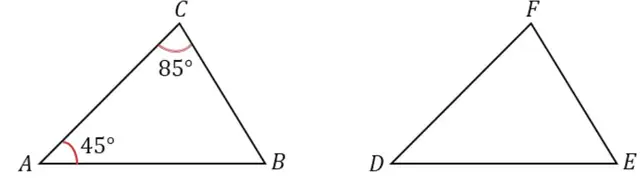
- △ABC ≡ △DEF means AB ≡ DE, BC ≡ EF, AC ≡ DF and ∠A ≡ ∠D, ∠B ≡ ∠E, ∠C ≡ ∠F.
- The order of the letters tells which vertices correspond.

a. If two triangles are congruent, then they have exactly same shape and size (True or False).
b. Any two equilateral triangles are congruent (True or False).
c. In the figure below, △ABC ≡ △DEF, ∠A = 45°, ∠C = 85°. Find the measures of ∠D and ∠E.
- We do not need all six parts to prove two triangles congruent.
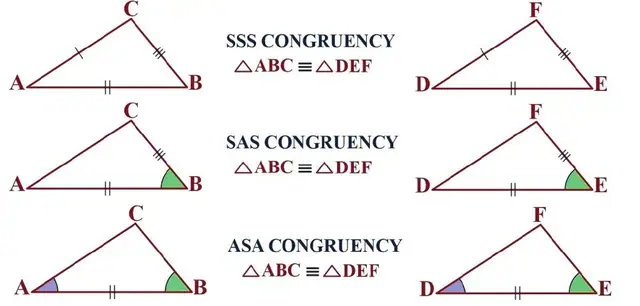
- Side-Side-Side (SSS): two triangles with equal corresponding sides are congruent.
- Side-Angle-Side (SAS): two pairs of equal sides and equal angles between those sides.
- Angle-Side-Angle (ASA): two pairs of equal angles and equal sides between those angles.
Read the full notes for all 7 sections, worked examples and figures, plus 17 exercises with step-by-step solutions, the Short Note and the unit review.
📑 Contents
- 7.1Revision on Congruency of TrianglesPreview
- 7.2Definition of Similar Figures🔒
- 7.3Theorems on Similar Plane Figures🔒
- 7.4Ratio of Perimeters of Similar Plane Figures🔒
- 7.5Ratio of Areas of Similar Plane Figures🔒
- 7.6Construction of Similar Figures🔒
- 7.7Applications of Similarity🔒
✍️ Practice questions
5 questions from the Unit 7 quiz. Choose an answer, then check it.
- 1
Two triangles are called "congruent" when they have:
- AThe same shape but different size
- BOnly equal angles
- COnly equal perimeters
- DExactly the same three sides and the same three angles
Show answer
D Exactly the same three sides and the same three angles
- 2
If △ABC ≡ △DEF, this notation indicates that vertex A corresponds to vertex:
- AF
- BAny vertex
- CD
- DE
Show answer
C D
- 3
Which of the following is a valid triangle congruency criterion?
- ASAS (side-angle-side, with the included angle)
- BAAA (three angles only)
- COnly right angles
- DSSA in general
Show answer
A SAS (side-angle-side, with the included angle)
- 4
In the SAS congruency criterion, the angle used must be the:
- ALargest angle
- BIncluded angle (between the two given sides)
- CAny angle in the triangle
- DAngle opposite the longest side
Show answer
B Included angle (between the two given sides)
- 5
In the ASA congruency criterion, the side used must be the:
- AIncluded side (between the two given angles)
- BLongest side
- CShortest side
- DHypotenuse only
Show answer
A Included side (between the two given angles)