
Unit 5
Basics of Electronics
Introduction
- Electronic devices influence our daily lives so much that it is almost impossible to spend even a few hours without them.
- Calculators, digital watches, mobile phones, televisions and computers are just some of the electronic devices we use every day.
- We depend on electronics because it simplifies our activities and our lifestyle.
- Electronics also plays an important role in the aerospace and automobile industries, and in medicine: equipment such as magnetic resonance imaging (MRI), computed tomography (CT) and X-ray machines relies on electronics to work quickly and accurately.
- In this unit you study the building blocks of electronic circuits.
- You start with semiconductors and doping, then see how a P-N junction makes a diode and how diodes rectify alternating current.
- Next you meet the bipolar junction transistor, which amplifies and switches signals, and the integrated circuit, which puts thousands to billions of components on one chip.
- Finally you learn the logic gates of digital electronics and the many ways electronics is applied in medicine, agriculture, communication, transport and defence.
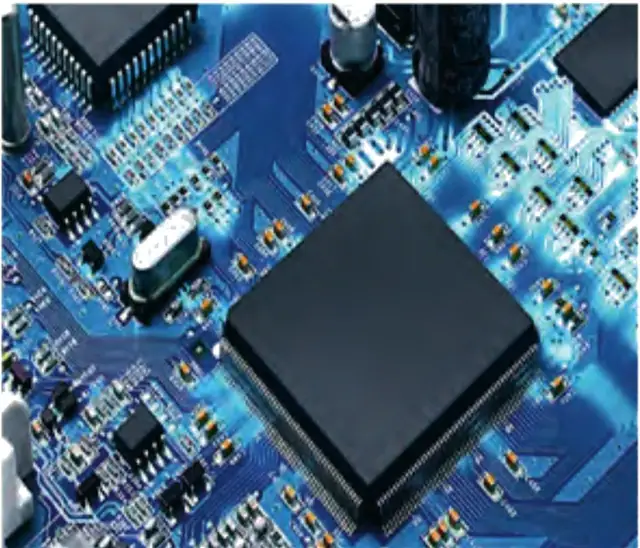
- Brainstorming question 5.1 asks you to look at the circuit board above and list the basic components used to build electronic circuits.
- The main ones are resistors, capacitors, inductors (coils), diodes (including LEDs), transistors and integrated circuits (chips).
- They are soldered onto a printed circuit board whose copper tracks connect them, and the board is powered by a battery or a power supply.
🎯 Learning Outcomes
- Appreciate the characteristics of the P-N junction diode and its applications in electronics.
- Explain the difference between conductors, insulators and semiconductors, and how doping produces N-type and P-type material.
- Describe forward and reverse bias, the I–V characteristic of a diode and half-wave and full-wave rectification.
- Understand the construction and characteristics of the bipolar transistor and its use as an amplifier and a switch.
- Appreciate the use of digital electronics in electronic switching and integrated circuits.
- Draw the symbols, switch circuits and truth tables of the basic logic gates and analyse simple logic circuits.
- Understand the application areas of electronics.
5.1 Semiconductors
- By the end of this section you should be able to describe the difference between a conductor, an insulator and a semiconductor, give examples of semiconductor elements, distinguish between intrinsic and extrinsic semiconductors and between N-type and P-type material, and explain how doping helps current to flow.
- Brainstorming question 5.2 asks why metals are good conductors and insulators are poor ones.
- The answer lies in how many charge carriers are free to move inside each material.
5.1.1Conductors, Insulators and Semiconductors
- Conductors are materials that allow electricity to flow through them easily.
- Metals such as copper, silver and aluminium are good conductors.
- In a metal the outermost electrons are not tied to any one atom; these free electrons drift through the metal when a voltage is applied, and this drift is the electric current.
- Insulators are materials that do not allow electricity to pass through them.
- In an insulator every electron is tightly bound to its parent atom, so there are practically no free charge carriers.
- Plastic, wood, glass and rubber are good electrical insulators.
- That is why they are used to cover wires and other parts that carry electricity.
- Semiconductors are materials whose conductivity lies between that of conductors and insulators.
- They can be pure elements, such as silicon (Si) and germanium (Ge), or compounds such as gallium arsenide (GaAs) and cadmium selenide (CdSe).
- A semiconductor acts as an insulator at absolute zero (0 K) and as a conductor at higher temperatures.
- Conduction increases with temperature because heat gives the bonding electrons enough energy to break away from their covalent bonds.
- These freed electrons, and the holes they leave behind, can then move through the material and carry current.
🔒
The rest of Unit 5 is in the Danulearn app
Read the full notes for all 7 sections, worked examples and figures, plus 8 exercises with step-by-step solutions, the Short Note and the unit review.
📑 Contents
- 5.1SemiconductorsPreview
- 5.2Diodes and Their Functions🔒
- 5.3Rectification🔒
- 5.4Transistors and Their Application🔒
- 5.5Integrated Circuits🔒
- 5.6Logic Gates and Logic Circuits🔒
- 5.7Application of Electronics🔒
✍️ Practice questions
5 questions from the Unit 5 quiz. Choose an answer, then check it.
- 1
Semiconductors are materials whose electrical conductivity lies between that of:
- AGases and liquids
- BMagnets and non-magnets
- CInsulators and conductors
- DSolids and plasmas
Show answer
C Insulators and conductors
- 2
A commonly cited example of a semiconductor element is:
- ASilicon
- BGold
- CCopper
- DAluminum
Show answer
A Silicon
- 3
At absolute zero temperature, an intrinsic (pure) semiconductor behaves like a(n):
- AMagnet
- BSuperconductor
- CPerfect conductor
- DInsulator
Show answer
D Insulator
- 4
An intrinsic semiconductor is defined as one that is:
- AComposed of only one kind of material with no added impurities (undoped)
- BAlways in liquid form
- CMade purely of metal
- DAlways doped heavily with impurities
Show answer
A Composed of only one kind of material with no added impurities (undoped)
- 5
The process of adding small amounts of selected impurity atoms to a pure semiconductor to change its electrical properties is called:
- AAmplification
- BInduction
- CDoping
- DRectification
Show answer
C Doping