
Two-Dimensional Motion
- Kinematics is the study of motion without considering its causes, for example describing the path of a football without asking which forces start or change its motion.
- In Grade 11 you studied kinematics in one dimension, that is, motion along a straight line.
- Two-dimensional kinematics is a simple extension of those ideas to motion in a plane, where position, velocity and acceleration each have an x-component and a y-component.
- Most motions in nature follow curved paths rather than straight lines.
- A ball kicked by a football player, a bicycle rounding a curve, the turning wheels of a car and the orbits of the planets around the Sun are all examples of two-dimensional motion.
- In this unit you will study projectile motion, rotational kinematics and dynamics, the motion of the planets described by Kepler's laws, and Newton's law of universal gravitation that explains them.
- Understand the basic ideas of two-dimensional motion.
- Describe the motion of objects in horizontal and inclined projection and derive the equations of projectile motion.
- Calculate the time of flight, range, maximum height and velocity of a projectile.
- Describe uniform rotational motion using angular displacement, angular velocity and angular acceleration, and relate them to linear quantities.
- Explain torque and moment of inertia and use τ = Iα to solve rotational dynamics problems.
- State and apply Kepler's three laws of planetary motion.
- State Newton's law of universal gravitation and use it to explain planetary and satellite orbits.
- Develop pertinent problem-solving skills.
- A projectile is any object that is thrown, fired or released and then moves only under the influence of the gravitational force.
- Once it is launched, its only acceleration is the acceleration due to gravity, , directed vertically downward.
- The path that a projectile follows is called its trajectory.
- Examples of projectile motion: a football kicked in a game, a ball thrown horizontally into the air, a cannonball fired from a cannon, a bullet fired from a gun, a javelin thrown by an athlete, the flight of a golf ball and a jet of water escaping from a hose.
- A bird flying in the air is NOT a projectile: it keeps pushing on the air with its wings, so forces other than gravity (lift and thrust) act on it and control its path.
- Anyone who has watched a ball kicked by a football player has seen projectile motion: the ball moves along a curved path and returns to the ground.
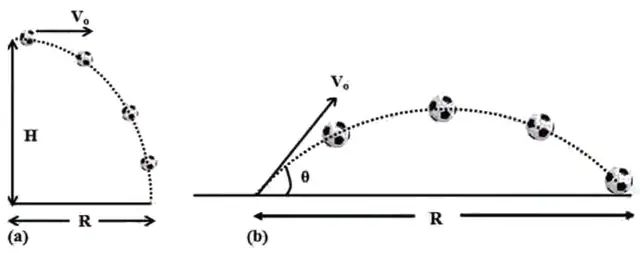
- Projectile motion is simple to analyse if we make three assumptions.
- With these assumptions the trajectory of every projectile turns out to be a parabola.
- The free-fall acceleration is constant over the range of the motion and is always directed downward; it is the acceleration due to gravity, .
- The effect of air resistance is negligible.
- The horizontal velocity is constant, because the acceleration of the projectile has no horizontal component (, ).
- The horizontal and vertical components of a projectile's motion are completely independent of each other.
- They can therefore be handled separately, as two one-dimensional motions, with the time t as the common variable that links them.
Read the full notes for all 5 sections, worked examples and figures, plus 6 exercises with step-by-step solutions, the Short Note and the unit review.
📑 Contents
- 2.1Projectile MotionPreview
- 2.2Rotational Motion🔒
- 2.3Rotational Dynamics🔒
- 2.4Planetary Motion and Kepler's Laws🔒
- 2.5Newton's Law of Universal Gravitation🔒
✍️ Practice questions
5 questions from the Unit 2 quiz. Choose an answer, then check it.
- 1
Projectile motion is defined as the motion of an object that:
- AMoves in a perfectly straight line at constant speed
- BHas zero acceleration at all times
- COnly occurs in outer space
- DMoves only under the influence of gravity after being launched, following a curved path
Show answer
D Moves only under the influence of gravity after being launched, following a curved path
- 2
In analyzing projectile motion, the acceleration due to gravity, g, is taken as approximately:
- A1.0 m/s²
- B9.8 m/s²
- C3.0 × 10⁸ m/s²
- D6.67 m/s²
Show answer
B 9.8 m/s²
- 3
The path traced by a projectile under the standard assumptions of projectile motion is a:
- ACircle
- BEllipse
- CParabola
- DStraight line
Show answer
C Parabola
- 4
In projectile motion, the horizontal component of velocity, in the absence of air resistance, remains:
- AContinuously increasing
- BZero at all times
- CConstant throughout the motion
- DContinuously decreasing
Show answer
C Constant throughout the motion
- 5
In projectile motion, the vertical component of velocity is affected by:
- AGravitational acceleration only
- BBoth gravity and the horizontal velocity
- CNothing; it stays constant
- DAir pressure only
Show answer
A Gravitational acceleration only