
Unit 3
Fluid Mechanics
Introduction
- Matter most commonly exists as a solid, a liquid or a gas.
- Liquids and gases are both called fluids because, unlike solids, they cannot resist a change of shape: a fluid moves, or flows, when a force acts on it.
- Fluid mechanics is the branch of physics that studies the behaviour of fluids at rest (fluid statics) and in motion (fluid dynamics).
- Fluid mechanics has a very wide range of applications in mechanical and aerodynamic engineering, in biological systems such as blood flow and breathing, in weather and in everyday life.
- In this unit you will learn why an over-inflated balloon bursts, how a heavy car can be lifted by a small force, why a ship made of steel floats, how a pipe or a nozzle changes the speed of water, how an aeroplane is lifted against gravity, and how to work safely with high-pressure equipment.
🎯 Learning Outcomes
- Develop knowledge and understanding of the concepts related to fluids, density and pressure.
- Convert pressure between pascal, atm, mmHg (torr) and psi, and distinguish absolute, atmospheric and gauge pressure.
- State Pascal’s principle and explain how it is used in hydraulic machines.
- Describe how pressure varies with depth and explain how barometers and manometers measure pressure.
- State Archimedes’ principle and use it to explain floating and sinking.
- Understand the behaviour of fluid flow: steady and turbulent flow, flow rate, the equation of continuity and Bernoulli’s principle.
- Identify high-pressure systems, their applications, risks and safety measures.
- Develop skills of solving problems related to fluid mechanics.
3.1 Fluid Statics
- In this section you will explain the properties of solids, liquids and gases, define pressure and convert it from one unit to another, and explain how pressure arises in gases and liquids.
- You will also define absolute, atmospheric and gauge pressure, define density and relative density (specific gravity), and solve problems on pressure, density and specific gravity.
3.1.1Properties of Solids, Liquids and Gases
- Why are gases easy to compress, while liquids and solids are almost incompressible?
- The answer lies in how far apart the particles are and how strongly they attract one another.
- Figure 3.1 compares the arrangement of atoms in the three states of matter.
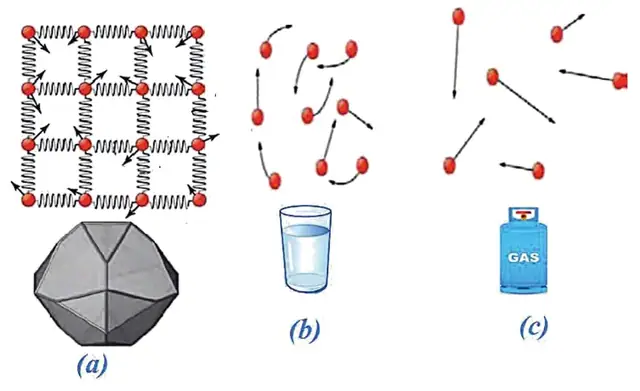
- Atoms in a solid are very close to each other.
- The forces between them act like springs that let the atoms vibrate without changing their positions relative to their neighbours.
- A solid therefore resists all types of stress, because its atoms cannot move about freely.
- Solids also resist compression, because their atoms are held at a fixed distance apart and would have to be forced into one another.
- The molecular spacing in a liquid is not much different from that in a solid, but the molecules are no longer fixed in position: they can rotate and translate freely.
- The intermolecular forces in a liquid are weaker than in a solid but still strong compared with a gas.
- A liquid deforms easily when stressed and does not spring back once the force is removed, because its atoms slide about and change neighbours.
🔒
The rest of Unit 3 is in the Danulearn app
Read the full notes for all 5 sections, worked examples and figures, plus 6 exercises with step-by-step solutions, the Short Note and the unit review.
📑 Contents
- 3.1Fluid StaticsPreview
- 3.2Pressure in Fluids at Rest🔒
- 3.3Archimedes’ Principle🔒
- 3.4Fluid Flow🔒
- 3.5Safety and High Pressure🔒
✍️ Practice questions
5 questions from the Unit 3 quiz. Choose an answer, then check it.
- 1
Pressure is defined as:
- AMass per unit volume
- BForce multiplied by area
- CNormal force exerted per unit area
- DForce per unit time
Show answer
C Normal force exerted per unit area
- 2
Pressure is classified as a scalar quantity because it:
- ADepends only on the magnitude of the force, not its direction
- BHas both magnitude and direction like a vector
- CCannot be measured
- DIs always negative
Show answer
A Depends only on the magnitude of the force, not its direction
- 3
The SI unit of pressure, equivalent to one newton per square meter, is called the:
- AJoule
- BPascal
- CNewton
- DWatt
Show answer
B Pascal
- 4
The absolute pressure at a point is defined relative to:
- AWater pressure at sea level
- BRoom temperature pressure
- CAtmospheric pressure
- DAbsolute vacuum (zero pressure)
Show answer
D Absolute vacuum (zero pressure)
- 5
Gauge pressure is defined as the difference between:
- ATwo different atmospheric pressures
- BForce and area only, without reference to atmosphere
- CDensity and volume
- DAbsolute pressure and local atmospheric pressure
Show answer
D Absolute pressure and local atmospheric pressure