
Unit 2
Emerging Technologies
Introduction
- An emerging technology is usually a new technology, but the term also covers the further evolution of an existing one.
- It is used for technologies that are in development or will become available within the next five to ten years, and it is normally reserved for technologies that are creating, or are expected to create, significant social or economic effects.
- In Grade 11 you met data science, artificial intelligence, virtual reality and augmented reality.
- This unit adds four more emerging technologies: Bigdata, cloud computing, fog computing and the Internet of Things (IoT).
🎯 Learning Outcomes
- Describe the meaning and use of Bigdata.
- Explain cloud computing and fog computing.
- Apply cloud computing services.
- Explain the Internet of Things (IoT) and its applications.
2.1 Introduction to Bigdata
- Every digital service we use generates data, and the amount keeps growing in every dimension.
- Bigdata is a collection of data sources so massive and complex that it becomes challenging to process with typical data processing software or ordinary database management tools.
- Bigdata began with the explosion of data since the start of the digital age.
- Computers, the Internet and technology that captures information from the physical world turn real events into digital data that can benefit businesses and organizations.
- Collecting Bigdata starts with identifying the sources that generate useful data: business firms producing transactional data (for example point-of-sale software), endpoint devices in IoT systems, social media posts from existing and prospective customers, smartphone location data, and surveys that ask customers directly.
- The organization then builds a pipeline that moves the data from where it is generated to where it is stored for use.
- Global companies such as search engines use Bigdata to understand what users want from parameters such as search history, location and trends.
2.1.1Characteristics of Bigdata
- Bigdata is characterized by the 5 V's: Volume, Variety, Velocity, Veracity and Value.
- More characteristics may be added as research in Bigdata analytics continues.
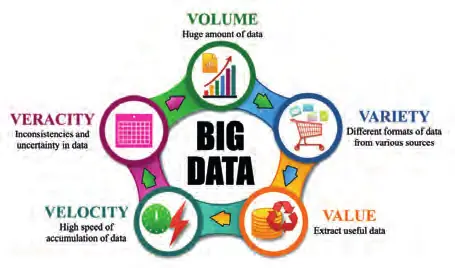
- Volume – The huge amount of data generated daily from social media, business processes, machines, networks and human interactions
- Variety – The nature of the data: structured, unstructured or semi-structured (emails, PDFs, photos, videos, audio, social media posts)
- Velocity – The speed at which data is created in real time
- Veracity – The degree of reliability the data has to offer
🔒
The rest of Unit 2 is in the Danulearn app
Read the full notes for all 4 sections, worked examples and figures, plus 7 exercises with step-by-step solutions, the Short Note and the unit review.
📑 Contents
- 2.1Introduction to BigdataPreview
- 2.2Cloud Computing🔒
- 2.3Fog Computing🔒
- 2.4Internet of Things (IoT)🔒