
Unit 7
Nuclear Physics
Introduction
- Nuclear physics is the field of physics that studies atomic nuclei, the particles they are made of and the interactions that hold them together.
- Nuclear processes include radioactive decay, the splitting of a heavy nucleus (fission) and the joining of light nuclei (fusion).
- The strong nuclear force binds protons and neutrons into nuclei, but it acts only over a very short distance of a few femtometres (1 fm = 10⁻¹⁵ m).
- A nuclide may be stable or unstable, and unstable nuclides emit alpha (α), beta (β) and gamma (γ) radiation spontaneously.
- Research reactors (RR), which mainly produce neutrons, and power reactors (PR), which generate electricity, are both based on fission and are now used all over the world, while controlled fusion is still being developed in laboratories.
- The fuels of nuclear processes are heavy unstable nuclei such as uranium, thorium and plutonium.
- Nuclear radiation ionises matter strongly and can be fatal to people if proper precautions are not taken, so the safety rules of the International Atomic Energy Agency (IAEA) must be followed and every country that runs reactors needs an independent inspection body.
- In this unit you will study the properties of nuclei, radioactivity, nuclear reactions and nuclear energy, the uses of radiation, and how to protect yourself from radiation hazards.
🎯 Learning Outcomes
- Appreciate the basic concept of the atomic nucleus and its constituent particles.
- Describe qualitatively the basic nuclear processes: radioactivity and nuclear reactions.
- Discuss the types of nuclear forces (strong and weak nuclear forces).
- Calculate the mass defect, binding energy and binding energy per nucleon of nuclei.
- Use the decay law, half-life and activity to solve problems on radioactive decay.
- Define nuclear fission, nuclear fusion and isotope, and explain the energy source of stars.
- Explain the applications of radioactivity and nuclear reactions to society, including nuclear medicine.
- Demonstrate a high level of awareness to protect yourself and your community from radiation hazards.
7.1 The Nucleus
- Think about these questions before you read: How do the volume and the mass of the nucleus compare with those of the whole atom?
- Who discovered the nucleus, and how?
- What force keeps protons and neutrons at the centre of the atom, and what force keeps the electrons and the nucleus together?
- This section answers all three.
About the Atom
- Atoms are the basic building blocks of matter.
- An atom consists of a positively charged central nucleus surrounded by one or more negatively charged electrons.
- The nucleus contains relatively heavy particles called protons (positively charged) and neutrons (electrically neutral).
- Protons and neutrons together are called nucleons.
- Every atom contains all three kinds of particle except the lightest isotope of hydrogen, whose nucleus is a single proton with no neutron.
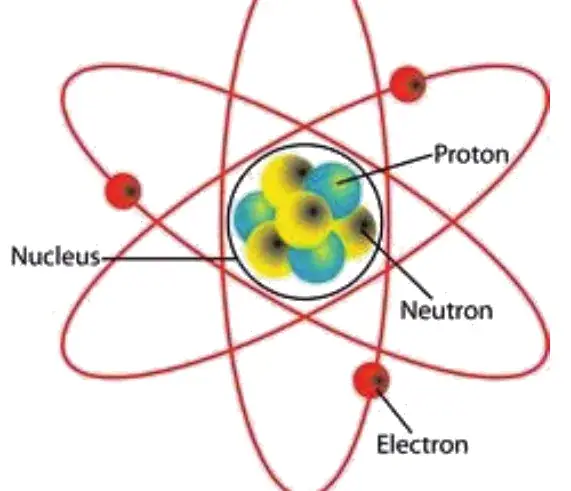
- The electron and the proton carry charges of the same size, , but of opposite sign, while the neutron has no charge.
- The proton and the neutron have almost the same mass, and each is about 1836 times as heavy as the electron.
- The masses of nuclear particles are usually given in atomic mass units (u), where (one twelfth of the mass of a carbon-12 atom).
| Particle | Charge (C) | Mass (kg) | Mass (u) |
|---|---|---|---|
| Electron | −1.602 × 10⁻¹⁹ | 9.1094 × 10⁻³¹ | 0.00054858 |
| Proton | +1.602 × 10⁻¹⁹ | 1.6726 × 10⁻²⁷ | 1.0072766 |
| Neutron | 0 | 1.6749 × 10⁻²⁷ | 1.0086654 |
Nuclide Notation
- The number of protons in the nucleus is the atomic number, Z.
- The number of neutrons is the neutron number, N.
- The total number of nucleons is the mass number, .
- Because the electrons are so light, the nucleus holds more than 99.9% of the mass of an atom.
🔒
The rest of Unit 7 is in the Danulearn app
Read the full notes for all 5 sections, worked examples and figures, plus 6 exercises with step-by-step solutions, the Short Note and the unit review.
📑 Contents
- 7.1The NucleusPreview
- 7.2Radioactivity🔒
- 7.3Use of Nuclear Radiation🔒
- 7.4Nuclear Reaction and Energy Production🔒
- 7.5Safety Rules Against Hazards of Nuclear Radiation🔒
✍️ Practice questions
5 questions from the Unit 7 quiz. Choose an answer, then check it.
- 1
The nucleus of an atom is composed of:
- AElectrons and neutrons only
- BProtons and electrons
- COnly neutrons
- DProtons and neutrons
Show answer
D Protons and neutrons
- 2
The atomic number of an element represents the number of:
- AProtons in the nucleus
- BTotal nucleons
- CNeutrons in the nucleus
- DElectrons in the outer shell only
Show answer
A Protons in the nucleus
- 3
The mass number of a nucleus represents the total number of:
- AProtons only
- BProtons and neutrons combined
- CNeutrons only
- DElectrons only
Show answer
B Protons and neutrons combined
- 4
Isotopes of an element have the same number of protons but different numbers of:
- AElectrons
- BNuclei
- CProtons
- DNeutrons
Show answer
D Neutrons
- 5
The strong nuclear force that holds protons and neutrons together in the nucleus is:
- AIdentical to gravity
- BRepulsive between all nucleons
- CWeaker than the electrostatic repulsion between protons
- DMuch stronger than the electrostatic force at very short nuclear distances
Show answer
D Much stronger than the electrostatic force at very short nuclear distances