
Unit 4
Dynamics
Introduction
- Motion is everywhere in nature: athletes racing, a bird flying, a dolphin jumping out of the water and the curved path of a football or a basketball.
- People have also built fast-moving machines such as cars, aeroplanes, magnetic levitation (Maglev) trains, supersonic jets and satellites orbiting the Earth.
- In Unit 3 you studied kinematics, which describes how objects move (their velocity and acceleration) without asking what causes the motion.
- Motion has a cause, and that cause is a force.
- Dynamics is the study of motion together with its cause.
- In this unit you will learn how forces create and change motion, and you will meet the closely related ideas of work, energy, power, momentum and impulse.
🎯 Learning Outcomes
- Demonstrate an understanding of the relationship between net force and the acceleration of an object in linear motion.
- Analyse the effect of a net force in quantitative terms, using graphs, free-body diagrams and vector diagrams.
- Describe the first condition of equilibrium quantitatively.
- Demonstrate an understanding, in qualitative and quantitative terms, of work, energy, energy transformations and power.
- Design and carry out experiments and solve problems involving energy transformations and the law of conservation of energy.
- Realise that momentum is an inherent property of moving objects.
- Express the relationship between impulse and momentum and apply conservation of momentum to collisions.
4.1 The Concept of Force and Newton’s Laws of Motion
4.1.1The Concept of Force
- Dynamics: the branch of mechanics that studies the motion of objects together with the force that causes the motion.
- To understand dynamics we start with a working definition of force.
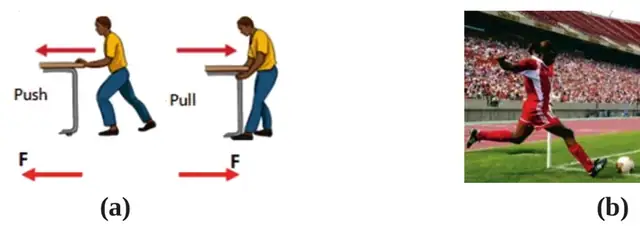
- In everyday language a force is a push or a pull, as when you push a table across the floor or a player kicks a ball.
- The speed and the direction of motion of the ball and of the table depend on both the size and the direction of the applied force.
- Force is therefore a vector quantity, just like velocity and acceleration.
- A force is an external agent that changes, or tends to change, the state of rest or the state of motion of a body.
- The SI unit of force is the newton (N): .
- Large forces are often given in kilonewtons: .
- Because force is a vector, two forces add by vector addition; the single force that has the same effect as all the forces together is the net (resultant) force .
- A force can produce several effects on a body.
- Apart from changing the speed of a body, the direction of its motion, or both, a force can also change the shape or size of a body.
- A tennis ball hit by a racket is squashed for a moment; this effect is called deformation.
- A force can start a body moving from rest.
- A force can stop a moving body or slow it down.
- A force can make a moving body go faster.
- A force can change the direction of motion of a body.
- A force can change the shape or size of a body (deformation), for example stretching a spring or squeezing a sponge.
- Forces are grouped into contact forces and field forces.
🔒
The rest of Unit 4 is in the Danulearn app
Read the full notes for all 6 sections, worked examples and figures, plus 7 exercises with step-by-step solutions, the Short Note and the unit review.
📑 Contents
- 4.1The Concept of Force and Newton’s Laws of MotionPreview
- 4.2Frictional Force🔒
- 4.3The First Condition of Equilibrium🔒
- 4.4Work, Energy and Power🔒
- 4.5Conservation of Mechanical Energy🔒
- 4.6Impulse and Linear Momentum🔒
✍️ Practice questions
5 questions from the Unit 4 quiz. Choose an answer, then check it.
- 1
Newton's First Law of Motion states that an object at rest or in uniform motion will remain so unless acted upon by a(n):
- ABalanced force
- BInternal force
- CFrictional force only
- DUnbalanced (net) external force
Show answer
D Unbalanced (net) external force
- 2
Another name for Newton's First Law is the law of:
- AInertia
- BAction-reaction
- CAcceleration
- DGravitation
Show answer
A Inertia
- 3
Newton's Second Law of Motion is mathematically expressed as:
- AF = a/m
- BF = m + a
- CF = m/a
- DF = ma
Show answer
D F = ma
- 4
According to Newton's Second Law, if the net force on an object doubles while mass stays constant, its acceleration:
- ABecomes zero
- BDoubles
- CHalves
- DRemains the same
Show answer
B Doubles
- 5
Newton's Third Law states that for every action, there is a(n):
- ASmaller reaction in the opposite direction
- BLarger reaction in the same direction
- CEqual and opposite reaction
- DNo reaction at all
Show answer
C Equal and opposite reaction