
Unit 6
Electrostatics and Electric Circuit
Introduction
- In this unit you study the two branches of electricity: electrostatics (static electricity) and current (dynamic) electricity.
- Electrostatics deals with the properties of electric charges at rest.
- Current electricity deals with the properties of charges in motion.
- The main difference between the two is that in static electricity the charges are stationary and build up on the surface of an insulator.
- In current electricity, electrons flow through a conductor and form an electric current.
- You will meet Coulomb's law, electric fields and potential, current, resistance and Ohm's law, measuring instruments, Kirchhoff's rules, capacitors and the circuits found in Ethiopian homes.
🎯 Learning Outcomes
- Calculate the electric field resulting from a point charge.
- Determine the magnitude and direction of the electric force among any point charges.
- Acquire knowledge and understanding of electrostatic phenomena.
- Demonstrate an understanding of the components and functions of electrical circuits commonly found at home and in the workplace.
- Construct and analyse simple electrical circuits using schematic diagrams, electrical tools and components, and everyday electrical devices and appliances.
- Define a capacitor and explain some of its applications in life.
- Apply Kirchhoff's rules to solve circuit problems.
- Note on numbering: the textbook has no section 6.5 – it jumps from 6.4 to 6.6.
- These notes keep the textbook's numbers so that you can find each section in your book.
6.1 Coulomb's Law
- By the end of this section you should be able to state Coulomb's law, calculate the magnitude and direction of the electric force between any two charges, explain Coulomb's law using vectors and explain the meaning of a coulomb.
- Before Coulomb's law, revise what you learnt in earlier grades about charge and its properties.
6.1.1Electric Charge
- Charge is the fundamental property of matter associated with the electrons and protons found in every atom.
- There are only two types of charge: negative and positive.
- By convention, electrons carry negative charge and protons carry positive charge.
- Neutrons in the nucleus carry no charge.
- Neutral object: the number of electrons equals the number of protons, so the charges cancel.
- Charged object: this electrical balance has been disturbed.
- Negatively charged object: it has more electrons than protons (it has gained electrons).
- Positively charged object: it has more protons than electrons (it has lost electrons).
- Only electrons move when ordinary objects are charged; the protons stay locked in the nuclei.
6.1.2Properties of Electric Charges
- Property I – There are two kinds of electric charge: positive and negative.
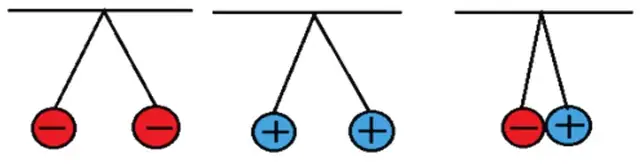
- Property II – Two similarly charged bodies repel each other and two oppositely charged bodies attract each other.
- Property III – Electric charge is always conserved: it cannot be created or destroyed. In any charging process the number of electrons gained by one object equals the number of electrons lost by the other.
- Property IV – Electric charge is quantized: it comes in discrete packets, always an integral multiple of the elementary charge e. In symbols , where
🔒
The rest of Unit 6 is in the Danulearn app
Read the full notes for all 6 sections, worked examples and figures, plus 7 exercises with step-by-step solutions, the Short Note and the unit review.
📑 Contents
- 6.1Coulomb's LawPreview
- 6.2Electric Fields🔒
- 6.3Electric Potential🔒
- 6.4Electric Current, Resistance and Ohm's Law🔒
- 6.6Capacitors and Capacitance🔒
- 6.7Electric Circuits in Our Surroundings🔒
✍️ Practice questions
5 questions from the Unit 6 quiz. Choose an answer, then check it.
- 1
Electric charge exists in two types, which are:
- APositive and negative
- BStrong and weak
- CStatic and dynamic
- DReal and virtual
Show answer
A Positive and negative
- 2
Like charges __________ each other, while unlike charges __________ each other.
- Aattract; attract
- Battract; repel
- Crepel; attract
- Drepel; repel
Show answer
C repel; attract
- 3
The SI unit of electric charge is the:
- AAmpere
- BCoulomb
- CVolt
- DOhm
Show answer
B Coulomb
- 4
Coulomb's Law describes the force between two point charges as:
- AInversely proportional to the charges
- BIndependent of distance
- CDirectly proportional to distance squared
- DDirectly proportional to the product of the charges and inversely proportional to the square of the distance between them
Show answer
D Directly proportional to the product of the charges and inversely proportional to the square of the distance between them
- 5
According to Coulomb's Law, if the distance between two charges is doubled, the force between them:
- AStays the same
- BBecomes four times larger
- CDoubles
- DBecomes four times smaller
Show answer
D Becomes four times smaller