
Major Global Environmental Changes
- Human actions have a huge negative impact on the ecology of the planet.
- Ecological, biological, sociological and technological limits can lead to long-term (persistent) and emerging environmental changes.
- The key components of the world’s environmental challenges are environmental degradation, poverty, habitat fragmentation, overexploitation of resources, forest degradation and unsustainable development.
- This unit covers the persistent environmental changes – habitat destruction, agricultural intensification, overexploitation of resources and invasive alien species – the poverty–environment nexus (poverty and land degradation, poverty and deforestation), and environmental degradation and sustainable development.
- Describe the nature and characteristics of persistent environmental changes.
- Explain the nature and characteristics of emerging environmental changes such as invasive species.
- Examine the intricate relationships between poverty and the environment.
- Recognise that a sustainable environment is part of sustainable development.
- A habitat is the subset of physical environmental factors that permit a particular species to survive and reproduce – all the features of the environment surrounding an individual animal at any given time.
- Several related terms describe what happens to habitats: habitat loss or destruction (the habitat is removed completely, e.g. a forest cleared for a farm); habitat fragmentation (a continuous habitat is broken into smaller, isolated patches separated by farms, roads or settlements); habitat degradation (the habitat remains but its quality declines – fewer large trees, polluted water, invasive weeds); and habitat conversion (the habitat is changed into another land use).
- Landscape modification by humans is by far the most important modern source of habitat loss, fragmentation and biodiversity loss on the planet.
- Humans alter landscapes and habitats spatially through five processes: perforation (making holes in a habitat, e.g. clearings or houses within a forest), dissection (cutting it with roads or power lines), fragmentation (breaking it into separate patches), shrinkage (reducing the size of the patches) and attrition (the disappearance of the remaining small patches).
- Natural processes – floods, volcanic eruptions, earthquakes and temperature shifts – also change landscapes and eliminate habitats.
- The introduction of invasive species is another major cause of the extinction of native species.
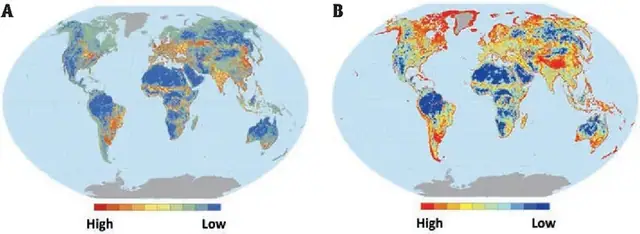
- Figure 6.1 shows the species richness (biodiversity) of the world’s terrestrial mammals (A) and the degree of habitat fragmentation (B), blue being the least and red the most fragmented areas.
Read the full notes for all 3 sections, worked examples and figures, plus 4 exercises with step-by-step solutions, the Short Note and the unit review.
📑 Contents
- 6.1Persistent Environmental ChangesPreview
- 6.2Poverty–Environment Nexus🔒
- 6.3Environmental Degradation and Sustainable Development🔒
✍️ Practice questions
5 questions from the Unit 6 quiz. Choose an answer, then check it.
- 1
Habitat destruction is primarily caused by:
- ANatural climate cycles alone
- BVolcanic eruptions only
- COcean currents
- DHuman activities such as agriculture, logging, and urban expansion
Show answer
D Human activities such as agriculture, logging, and urban expansion
- 2
Agricultural intensification refers to:
- APurely organic subsistence farming
- BAbandoning farmland
- CIncreasing output per unit of land through greater inputs and technology
- DReducing farm output
Show answer
C Increasing output per unit of land through greater inputs and technology
- 3
Overexploitation of resources occurs when:
- AResources are consumed faster than they can regenerate
- BResources are left completely untouched
- CResource use decreases over time
- DResources are used at a sustainable rate
Show answer
A Resources are consumed faster than they can regenerate
- 4
Invasive alien species mainly threaten ecosystems by:
- AImproving soil fertility
- BOutcompeting native species and disrupting ecological balance
- CIncreasing biodiversity uniformly
- DCoexisting peacefully with native species
Show answer
B Outcompeting native species and disrupting ecological balance
- 5
The "poverty-environment nexus" describes the relationship between:
- ATourism and pollution
- BWealth and technology
- CPoverty and environmental degradation, which can reinforce each other
- DUrban growth and literacy
Show answer
C Poverty and environmental degradation, which can reinforce each other