
Unit 1
Continents and Oceans
Introduction
- Do you remember the lessons on the ‘Geological History of Ethiopia’ and the ‘Landforms of Africa’ in your Grade 9 and Grade 10 Geography?
- Geological history is the record of how the Earth and its rocks, landforms and life have developed through time.
- In Unit 1 of Grade 11 Geography you will learn about the timescale of the Earth’s geological processes, the development stages of the Earth’s continents, and the relative position (distribution) of the Earth’s oceans and continental landmasses.
- With these basic contents you are expected to be aware of and appreciate the Earth’s geological timescale, the formation of the continents, and the relative distribution of the oceans and continents.
🎯 Learning Outcomes
- Recognise the Earth’s geological history.
- Describe the formation of the Earth’s continents.
- Explain the relative distribution of continents and oceans over the globe.
- Appreciate the changing positions of the Earth’s continents and oceans over geological time.
1.1 Formation of Continents
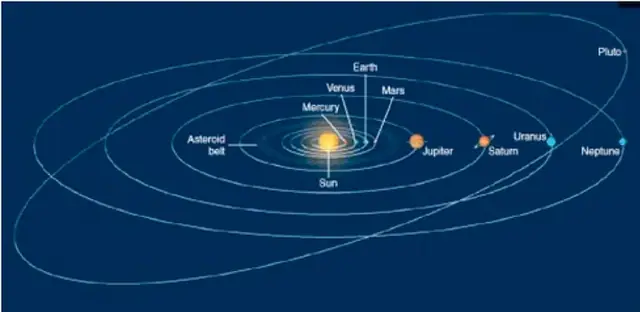
- The Earth, together with the other planets and their moons, forms the planetary system; the Sun and the planets together form the Solar System.
- The formation of the Earth is attributed to the same process that created its companion planets and the entire Solar System, so it is necessary to understand the origin of the Solar System to understand the foundation of the Earth.
- Earth-science literature contains different views and theories on the formation of the Earth and the Solar System; most depend on speculation and ambiguous assumptions, and none of them can acceptably demonstrate all the ultimate features of the Earth and the Solar System.
- Among the various theories proposed, the ‘Big Bang’ is the most widely supported by scientists.
- According to this theory the Universe originated some 10–20 billion years ago (current estimate 13.8 billion) by an abrupt cosmic explosion initiated by the expansion of a small volume of matter at exceedingly high density and temperature.
- This space explosion was followed by the formation of numerous space objects – the Sun, planets, stars, meteors, asteroids and comets – through material collision, cooling and gravitational attraction (the nebular hypothesis: a rotating cloud of gas and dust collapsed into a disc, the Sun forming at the centre and the planets from the rings of material around it).
- Our Earth was thus created from the mixture of gas and dust particles moving in space around the Sun about 4.5 billion years ago.
- How were the continents formed?
- The first cosmic rocks solidified and created the first Earth at about 4 600 to 3 900 Ma (million years ago).
- The stages that followed are:
🔒
The rest of Unit 1 is in the Danulearn app
Read the full notes for all 4 sections, worked examples and figures, plus 5 exercises with step-by-step solutions, the Short Note and the unit review.
📑 Contents
- 1.1Formation of ContinentsPreview
- 1.2Geological Timescale🔒
- 1.3Distribution of the Continents and Oceans🔒
- 1.4Changing Positions of Continents and Oceans over Geological Time🔒
✍️ Practice questions
5 questions from the Unit 1 quiz. Choose an answer, then check it.
- 1
Which of the following is the largest unit into which the geologic time scale is divided?
- AEras
- BPeriods
- CEpochs
- DEons
Show answer
D Eons
- 2
The relative age of rock layers is most commonly determined using:
- AThe law of superposition (position within rock layers)
- BCounting fossils only
- CRadiometric dating
- DCarbon dating
Show answer
A The law of superposition (position within rock layers)
- 3
The absolute age of rocks is most reliably determined using:
- ARock color
- BRadiometric (isotopic) dating
- CSuperposition
- DLayer thickness
Show answer
B Radiometric (isotopic) dating
- 4
Continental drift theory, a precursor to plate tectonics, was proposed by:
- AAlfred Wegener
- BCharles Darwin
- CJames Hutton
- DIsaac Newton
Show answer
A Alfred Wegener
- 5
The supercontinent that broke apart to form today's continents is known as:
- ARodinia
- BLaurasia
- CGondwana
- DPangaea
Show answer
D Pangaea