
Global Population Dynamics and Changes
- Population study is one of the topics covered by geographic education in schools, colleges and universities.
- Population geography is the branch of geography that deals with population issues: it focuses on the size, composition, spatial distribution and changes of population across time.
- Three essential processes – fertility, mortality and migration – define the pattern of population growth.
- Global population dynamics affect global resource availability and demand.
- The rapid increase of population over the last few decades has put significant strain on the worldwide ecosystem; the modern world experiences exponential population expansion, which results in inadequate food supply, insufficient supply of non-renewable resources, over-exploitation of renewable resources and environmental degradation.
- Population geographers have therefore focused on the study of population growth patterns and international migration in response to the imbalance between the pace of population growth and socio-economic progress.
- This unit covers population growth trends, the factors behind rapid growth, the measures of fertility, mortality and migration, international migration and population policies.
- Examine the trend of world population growth.
- Recognise the key factors behind major population problems.
- Compare and contrast the population growth trends of Less Developed Countries (LDCs) and More Developed Countries (MDCs).
- Calculate and interpret the main measures of fertility, mortality and migration.
- Assess the factors underlying international migration.
- Evaluate population policies on growth, socio-economic development, migration and distribution.
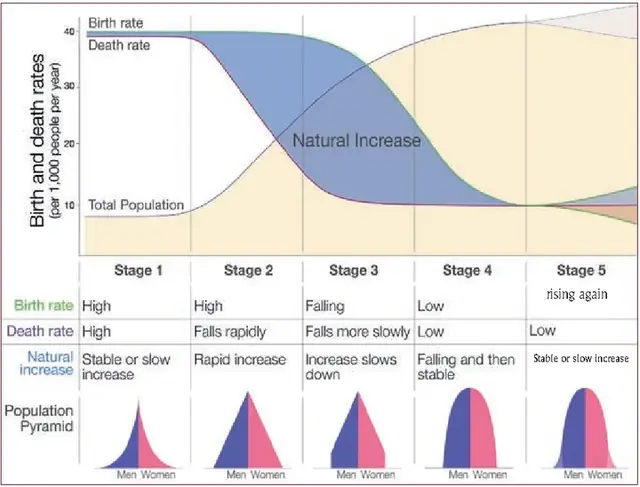
The demographic transition model describes how a population passes from high birth and death rates to low birth and death rates as a country develops.
- Stage 1 – high stationary: both fertility and mortality are high and fluctuating, so population growth is slow. The regular triangular-shaped age pyramid characterised the more developed countries before the 17th and 18th centuries; only a few less developed countries remain in this category today. A youthful population with a small old-age group foretells rapid growth as the young enter the reproductive period.
- Stage 2 – early expanding: death rates fall, notably among children aged 0–5, because of better food supply, sanitation and medicine, while birth rates remain high – so population grows very rapidly.
- Stage 3 – late expanding: the birth rate falls, mainly because of socio-economic change, urbanisation and widespread use of contraception; population continues to grow but at a slower pace. The industrialised countries began this transition from the 18th century.
- Stage 4 – low stationary: birth rates fall to levels equal to death rates, so the population grows only slowly or is stable.
- Stage 5 – the birth rate may rise slightly again while the death rate stays low, giving stable or slow growth (in many countries today, e.g. Japan, Italy, Germany, the birth rate has fallen below the death rate and the population declines).
- Human population growth was modest until the mid-19th century, when birth rates were only slightly greater than death rates; in the 20th century the human population expanded faster than ever before.
Read the full notes for all 4 sections, worked examples and figures, plus 5 exercises with step-by-step solutions, the Short Note and the unit review.
📑 Contents
- 4.1The Growth of World PopulationPreview
- 4.2Factors Responsible for Accelerated Population Growth🔒
- 4.3International Migration🔒
- 4.4Population Policies🔒
✍️ Practice questions
5 questions from the Unit 4 quiz. Choose an answer, then check it.
- 1
Population growth trends in Less Developed Countries (LDCs) are generally characterized by:
- ARelatively high birth rates and rapid population growth
- BZero population growth
- CNet emigration
- DDeclining birth rates and shrinking populations
Show answer
A Relatively high birth rates and rapid population growth
- 2
Population trends in More Developed Countries (MDCs) typically show:
- ANo aging population
- BExtremely high fertility rates
- CLow birth rates and slower or stagnant growth
- DRapid population growth
Show answer
C Low birth rates and slower or stagnant growth
- 3
Fertility is most commonly measured using which indicator?
- ALife expectancy alone
- BGDP per capita
- CLiteracy rate
- DTotal Fertility Rate (TFR)
Show answer
D Total Fertility Rate (TFR)
- 4
International migration refers to:
- AMovement of people within a single country
- BSeasonal movement of animals
- CMovement of people across national borders
- DInternal rural-to-urban movement only
Show answer
C Movement of people across national borders
- 5
Population policies on growth typically aim to:
- AInfluence birth rates, migration, or distribution in line with development goals
- BEliminate all migration
- CIgnore demographic trends
- DIncrease mortality rates
Show answer
A Influence birth rates, migration, or distribution in line with development goals