
Society and Politics in the Age of World Wars (1914–1945)
- Unit 4 deals with the history of the world from the beginning of the First World War in 1914 to the end of the Second World War in 1945.
- You will study the causes, course and consequences of the First World War, the October Socialist Revolution in Russia, the League of Nations, the Great Depression, the rise of Fascism, Nazism and militarism, and the Second World War.
- Charts, maps and pictures help explain the main points.
- Distinguish the major causes, courses and consequences of World War I and World War II.
- Discuss the causes and consequences of the Socialist Revolution in Russia.
- Identify the causes and impacts of the Great Depression.
- Compare and contrast Fascism, Nazism and militarism.
- Examine the causes of the failure of the League of Nations to protect the world from devastating war.
What were the causes of WWI?
What were the two military blocs during WWI?
The First World War (1914–18), often called the Great War, was an international conflict that involved most of the nations of Europe, along with Russia, the United States, the Middle East and other regions.
- Mutual defence alliances.
- Growing rivalries and mutual mistrust led to several military alliances among the Great Powers as early as the 1870s.
- The alliance system was designed to keep peace in Europe, but it pushed the continent into war instead.
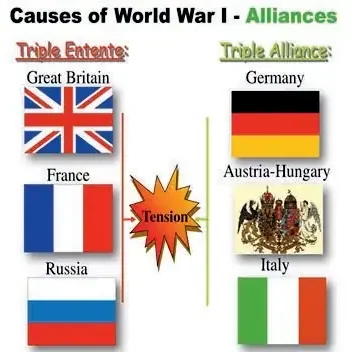
- The major military alliances in WWI were the Triple Alliance and the Triple Entente.
- The Triple Alliance, also known as the Central Powers, was formed in 1882 by Germany, Austria-Hungary and Italy.
- Italy later left it and joined the Triple Entente in 1915.
- The Triple Entente developed from the Franco-Russian Alliance of 1894, which was followed by the British and French Entente Cordiale of 1904.
- It became a Triple Entente after the Anglo-Russian Agreement of 1907.
- More than twenty countries, including the USA, Japan, the Union of South Africa, Portugal and Rumania, joined the Triple Entente, which was also named the Allied Powers.
- Imperialism.
- Another force that helped set the stage for war in Europe was imperialism.
- The nations of Europe competed fiercely for colonies in Africa and Asia.
- The quest for colonies sometimes pushed European nations to the brink of war.
Read the full notes for all 6 sections, worked examples and figures, plus 14 exercises with step-by-step solutions, the Short Note and the unit review.
📑 Contents
- 4.1The First World War: Causes, Course and ConsequencesPreview
- 4.2The October 1917 Russian Revolution: Cause, Course and Results🔒
- 4.3The League of Nations🔒
- 4.4The Worldwide Economic Crisis🔒
- 4.5The Rise of Fascism in Italy, Nazism in Germany and Militarism in Japan🔒
- 4.6The Second World War: 1939–45🔒
✍️ Practice questions
5 questions from the Unit 4 quiz. Choose an answer, then check it.
- 1
The Triple Alliance (Central Powers) originally comprised Germany, Austria-Hungary, and:
- AItaly
- BRussia
- CBritain
- DFrance
Show answer
A Italy
- 2
The Triple Entente grew from alliances among Britain, France, and:
- AItaly
- BJapan
- Cthe USA
- DRussia
Show answer
D Russia
- 3
The immediate cause of World War I was:
- AThe Great Depression
- BThe assassination of Archduke Franz Ferdinand
- CThe Russian Revolution
- DThe Treaty of Versailles
Show answer
B The assassination of Archduke Franz Ferdinand
- 4
Archduke Franz Ferdinand was assassinated by:
- AGavrilo Princip, a Serbian nationalist
- BA Russian revolutionary
- CAn Italian anarchist
- DA German soldier
Show answer
A Gavrilo Princip, a Serbian nationalist
- 5
Germany's WWI strategy to quickly defeat France before turning against Russia was called the:
- AMarshall Plan
- BTruman Doctrine
- CDomino Theory
- DSchlieffen Plan
Show answer
D Schlieffen Plan