
Unit 3
Social, Economic and Political Developments in Ethiopia (mid-19th c. to 1941)
Introduction
- Unit 3 deals with the external aggressions against Ethiopia and the heroic resistance of the Ethiopian people, from the middle of the 19th century to 1941.
- It helps Ethiopians to understand how the country kept its territorial integrity.
- The first lesson looks at long distance trade and the part cottage industry played in the country’s economic life.
- The second lesson explains the making of the modern Ethiopian state, with its reforms, modernisation attempts and territorial expansion.
- The third lesson covers the Napier Expedition, the Egyptian and Mahdist invasions and the Italian attack that ended in the glorious Battle of Adwa in 1896.
- The fourth lesson deals with the power struggle among the ruling elites from 1906 to 1930.
- The last lesson is about Fascist Italian aggression and the patriots’ resistance.
🎯 Learning Outcomes
- Examine the interactions among people and states in Ethiopia in relation to long distance trade.
- Identify the major socio-economic and political reforms of the period.
- Describe the causes of external aggression and its consequences.
- Recognise the unity of the Ethiopian people against foreign aggression.
3.1 Long Distance Trade in the 19th Century and the Cottage Industry
3.1.1 The Trade Routes, People’s Interaction, Major Market Centres, the Medium of Exchange and Trade Items
✏️ Brainstorming
What is the importance of trade?
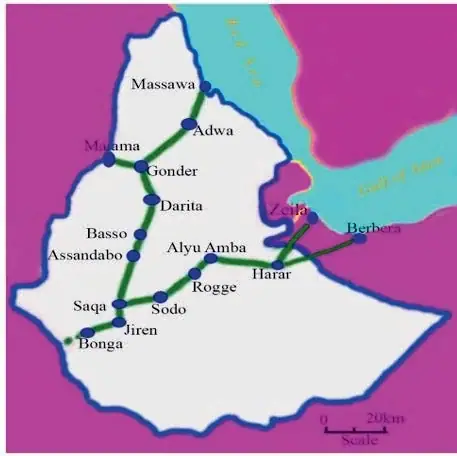
- In the 19th century, the peoples and polities of the southern, northern and eastern parts of Ethiopia and the Horn were connected by two major trade routes.
- Both started from Bonga, the capital of the Kafa Kingdom.
- The main market centres along the first route were Bonga, Hirmata, Saqa, Asandabo, Basso and Gondar.
- At Gondar it divided into two.
- The first went westward through Chilga to Matamma (Gallabat).
- The other passed through Adwa and Asmara and ended at Massawa on the Red Sea coast.
- The second major trade route also started from Bonga.
- It passed through the famous market centres of the century, such as Hirmata in Jimma, Soddo in southern Shewa, Rogge at the foot of Yarar Mountain, Aliyu Amba or Abdul Rasul in northern Shewa, and Harar in eastern Ethiopia.
- At Harar the route divided into two.
- One went to Zeyila and the other to Berbera, both on the Somali coast of the Indian Ocean.
- The principal commodities of the long distance trade in the century were ivory, civet musk, salt bars (amole) and slaves.
- The salt bars, called amole, served as a medium of exchange.
- They were used side by side with the Maria Theresa Thaler.
- This coin was introduced from Austria to the Horn of Africa by Arab traders at the end of the eighteenth century.
- The long distance traders came from different backgrounds.
- At each market centre, local peoples were active traders.
🔒
The rest of Unit 3 is in the Danulearn app
Read the full notes for all 5 sections, worked examples and figures, plus 21 exercises with step-by-step solutions, the Short Note and the unit review.
📑 Contents
- 3.1Long Distance Trade in the 19th Century and the Cottage IndustryPreview
- 3.2The Making of the Modern Ethiopian State, 1855–1913🔒
- 3.3External Aggressions and the Unity of the Ethiopian People in Defence of National Sovereignty, 1871–1896🔒
- 3.4The Inception of the Power Struggle among the Ruling Elites, 1906 to 1935🔒
- 3.5Fascist Italian Aggression and Patriotic Resistance🔒
✍️ Practice questions
5 questions from the Unit 3 quiz. Choose an answer, then check it.
- 1
The two major 19th-century Ethiopian trade routes both originated from:
- AMassawa
- BHarar
- CGondar
- DBonga
Show answer
D Bonga
- 2
Which coin served as a widely used medium of exchange in 19th-century Ethiopia?
- AMaria Theresa Thaler
- BOttoman Lira
- CBritish Pound
- DFrench Franc
Show answer
A Maria Theresa Thaler
- 3
Salt bars used as currency in 19th-century Ethiopian trade were called:
- AAmole
- BGult
- CQalad
- DRist
Show answer
A Amole
- 4
The Jabarti were best described as:
- ASouthwestern Muslim Oromo merchants
- BPortuguese trade agents
- CChristian highland farmers
- DNorthern Muslim merchants dominant in long-distance trade
Show answer
D Northern Muslim merchants dominant in long-distance trade
- 5
Tewodros II was crowned King of Kings of Ethiopia in:
- A1852
- B1853
- C1855
- D1868
Show answer
C 1855