
Unit 2
Measurements and Scientific Methods
Introduction
- Chemistry depends heavily on measurement, and everything a chemist claims has to be backed up by experiment.
- In this unit you will learn how measurements are made and written down properly, how uncertain they can be, and how the scientific method turns measurements into knowledge.
🎯 Learning Outcomes
- Use proper SI units.
- Identify the causes of uncertainty in measurement.
- Express the result of any calculation involving experimental data to the appropriate number of decimal places or significant figures.
- Apply scientific methods in solving problems.
- Demonstrate an understanding of experimental skills in chemistry.
- Demonstrate a knowledge of basic laboratory apparatuses and safety rules.
- Describe scientific inquiry skills: observing, inferring, predicting, comparing and contrasting, communicating, analyzing, classifying, applying, theorizing, measuring, asking questions, developing a hypothesis, designing an experiment, interpreting data, drawing conclusions, making generalizations and problem solving.
2.1 Measurements and Units in Chemistry
🎯 Learning Outcomes
- List the seven SI units and their prefixes.
- Describe the seven SI units and their prefixes.
- Write the names and symbols of derived SI units.
- Use the factor label method for solving problems and making conversions of SI units.
- Describe uncertainty of measurement.
- Identify the digits that are certain and the ones that are uncertain, given a number representing a measurement.
- Identify causes of uncertainty in measurement.
- Define precision and accuracy.
- Estimate the precision possible for any instrument used in the laboratory.
- Explain systematic and random errors.
- Analyze given data in terms of precision and accuracy.
- Define significant figures.
- Determine the number of significant figures in a calculated result.
- Use scientific notation in writing very large or very small numbers.
- Measurement is the comparison of a physical quantity to be measured with a unit of measurement, that is, with a fixed standard of measurement.
- On a centimeter scale, the centimeter unit is the standard of comparison.
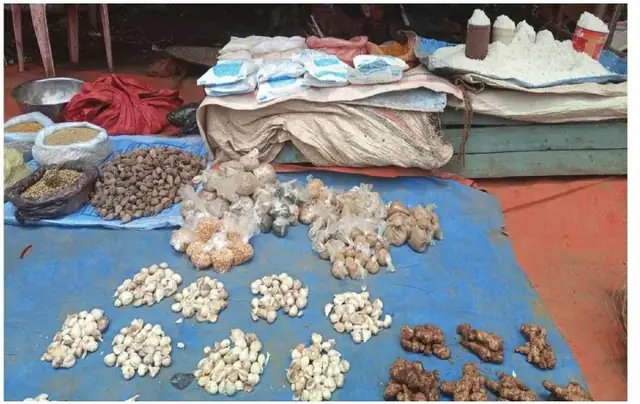
- In traditional markets people buy and sell goods by estimating their size in a traditional way or by using traditional measurement methods.
- Figure 2.1 shows a traditional market where people exchange goods by estimating their size using indigenous methods of measurement.
- The study of chemistry depends heavily on measurement.
- Chemists use measurements to compare the properties of different substances and to assess changes resulting from an experiment.
- A number of common devices enable us to make simple measurements of a substance’s properties: the meter stick measures length; the burette, the pipette, the graduated cylinder and the volumetric flask measure volume; the balance measures mass; the thermometer measures temperature.
🔒
The rest of Unit 2 is in the Danulearn app
Read the full notes for all 2 sections, worked examples and figures, plus 17 exercises with step-by-step solutions, the Short Note and the unit review.
📑 Contents
- 2.1Measurements and Units in ChemistryPreview
- 2.2Chemistry as Experimental Science🔒
✍️ Practice questions
5 questions from the Unit 2 quiz. Choose an answer, then check it.
- 1
Which international body proposed the revised metric system called the International System of Units (SI) in 1960?
- AThe General Conference of Weights and Measures
- BThe International Chemistry Society
- CThe United Nations
- DUNESCO
Show answer
A The General Conference of Weights and Measures
- 2
Which of the following is the correct SI base unit for temperature?
- ACelsius
- BFahrenheit
- CRankine
- DKelvin
Show answer
D Kelvin
- 3
The SI base unit for amount of substance is the:
- Aampere
- Bcandela
- Cmole
- Dgram
Show answer
C mole
- 4
The SI unit of electric current is the:
- Awatt
- Bohm
- Cvolt
- Dampere
Show answer
D ampere
- 5
The relationship between Kelvin and Celsius temperature scales is given by:
- AK = °C + 273.15
- BK = °C × 273.15
- CK = °C − 273.15
- DK = °C ÷ 273.15
Show answer
A K = °C + 273.15