
Chemistry and Its Importance
- Chemistry is so fundamental to our world that it plays a role in everyone’s life and touches almost every aspect of our existence.
- Chemistry is essential for meeting our basic needs such as food, clothing, shelter, health, energy, clean air, water, and soil.
- So how does it do all that?
In this unit you will study the definition and the scope of chemistry, the relationship between chemistry and the other natural sciences, the role chemistry plays in production and in society, and some common chemical industries in Ethiopia and their products.
- Define chemistry.
- Describe the scope of chemistry.
- Discuss the relationships between chemistry and physics, biology, medicine, geology and other subjects.
- Describe the application of chemistry in the fields of agriculture, medicine, food production and building construction.
- Name some common chemical industries in Ethiopia and their products.
- Define chemistry.
- Explain the scope of chemistry.
- In this section two things are dealt with: first the definition of chemistry, and then its scope.
- We begin with the definition.
Chemistry is the science that deals with the properties, composition, and structure of substances (elements and compounds), the transformations they undergo, and the energy that is released or absorbed during these processes.
That definition uses several important words, so let us take them one at a time:
- Substance – a particular kind of matter with uniform properties. Examples: gold, silver, water, soap and table salt.
- Matter – a physical substance; that which occupies space and possesses rest mass. Examples: a book, a pencil, a television and a stool.
- Property – the attribute, quality, or characteristic of a substance. Every substance in the universe has its own properties, and these are what let us tell one substance from another. Water, for example, is a substance that has no color, taste, or shape.
- Composition – the nature of something’s ingredients or constituents; how a whole or mixture is made up. Table salt is chemically composed of the elements sodium and chlorine. Stainless-steel spoons are a solid solution (alloy) of chromium, carbon and other elements.
- Structure – the arrangement of, and relationships between, the parts or elements of something complex. A school building, for instance, is made up of a roof, ceiling, doors, windows, walls and floor arranged in a certain order; the arrangement of these parts is the structure of the building.
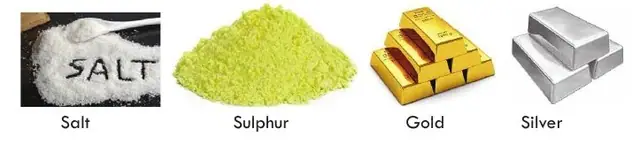
- Why does every substance have its own properties?
- Because every substance has its own unique composition and structure.
Read the full notes for all 4 sections, worked examples and figures, plus 8 exercises with step-by-step solutions, the Short Note and the unit review.
📑 Contents
- 1.1Definition and Scope of ChemistryPreview
- 1.2The Relationship Between Chemistry and Other Natural Sciences🔒
- 1.3The Role Chemistry Plays in Production and in the Society🔒
- 1.4Some Common Chemical Industries in Ethiopia🔒
✍️ Practice questions
5 questions from the Unit 1 quiz. Choose an answer, then check it.
- 1
Chemistry is best defined as the science that deals with the properties, composition, and structure of substances, their transformations, and:
- Athe classification of living organisms
- Bthe energy released or absorbed during these processes
- Cthe study of rocks only
- Dthe motion of planets
Show answer
B the energy released or absorbed during these processes
- 2
A physical substance that occupies space and possesses rest mass is called:
- Amatter
- Ban element
- Ca mixture
- Denergy
Show answer
A matter
- 3
The nature of something's ingredients or constituents, i.e., how a whole or mixture is made up, is called its:
- Atransformation
- Bproperty
- Cstructure
- Dcomposition
Show answer
D composition
- 4
The arrangement of and relationships between the parts of something complex is known as its:
- Aproperty
- Bsubstance
- Cstructure
- Dcomposition
Show answer
C structure
- 5
Which of the following is NOT one of the five main disciplines of chemistry mentioned in the textbook?
- AOrganic chemistry
- BNuclear chemistry
- CAnalytical chemistry
- DBiochemistry
Show answer
B Nuclear chemistry