
Unit 2
Climate Change
Introduction
- In the previous grade you learned about the climatic classification and regions of the world, the factors that influence the world’s climate and the indigenous climatic classification of Ethiopia.
- Climate change is one of the most significant environmental challenges facing humankind today.
- Though there are several arguments over the concept of climate change, scientifically speaking there is no doubt about the existence of global warming and climate change.
- It is now time to find out what actions will be taken in the political and social spheres to make our world more resilient and to fight climate change.
- Geography has much to contribute to the understanding of the complex spatial dimensions of climate change, including the observed and anticipated geographical differentiation in potential impacts and vulnerability.
- This unit addresses the basic concepts of climate change, global trends, the natural and human causes, the consequences, adaptation and mitigation strategies, international conventions and agreements, and finally the Climate Resilient Green Economy strategy of Ethiopia.
🎯 Learning Outcomes
- Explain the basic concepts of climate change.
- Distinguish between natural and human-induced climate change.
- Analyse trends in climate change in Ethiopia and the world at large.
- Recognise the major climate change mitigation and adaptation strategies.
- Assess the major international conventions and agreements in view of their aspirations and achievements.
- Explain the purpose and pillars of the Climate Resilient Green Economy strategy of Ethiopia.
2.1 Basic Concepts of Climate Change
- Recall how climate differs from weather from your own experience: if you decide what clothes to buy for the coming years you are thinking about climate; if you decide what to wear on a particular day you are thinking about weather.
- Weather is the condition of the atmosphere at a place over a short period (hours or days); climate is the average condition of the atmosphere in a certain place over many years (usually 30 years or more).
- For example, the climate of Gondar is cold in winter, and the climate of Gambella is warm and humid all year long.
- The climate of one area, such as the Horn of Africa, is called a regional climate; the average climate around the world is called the global climate.
- When scientists talk about global climate change they are talking about the global climate and a pattern of change that is happening over many years.
- One of the most important trends scientists look at is the average temperature of the Earth, which has been increasing for many years.
- This is called global warming.
- Rising global temperatures lead to other changes around the world, such as stronger hurricanes, melting glaciers and the loss of wildlife habitats, because the Earth’s air, water and land are all interdependent – a change in one place can lead to other changes somewhere else.
- For example, when air temperatures rise the oceans absorb more heat from the atmosphere and become warmer; warmer oceans, in turn, can cause stronger storms.
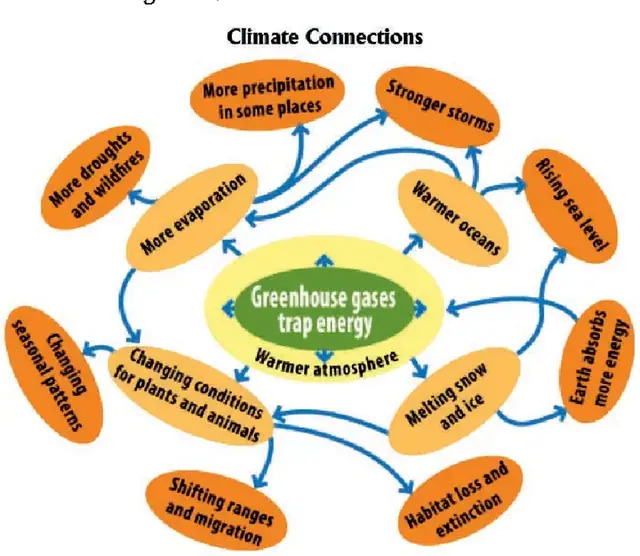
- According to the Intergovernmental Panel on Climate Change (IPCC), climate change refers to a change in the state of the climate that can be identified by changes in the mean and/or the variability of its properties and that persists for an extended period, typically decades or longer.
🔒
The rest of Unit 2 is in the Danulearn app
Read the full notes for all 7 sections, worked examples and figures, plus 8 exercises with step-by-step solutions, the Short Note and the unit review.
📑 Contents
- 2.1Basic Concepts of Climate ChangePreview
- 2.2Trends in Global Climate Change🔒
- 2.3Natural and Human-Induced Climate Change🔒
- 2.4Consequences of Climate Change🔒
- 2.5Adaptation and Mitigation Strategies to Climate Change🔒
- 2.6International Conventions and Agreements on Climate Change🔒
- 2.7Pillars of the Climate Resilient Green Economy of Ethiopia🔒
✍️ Practice questions
5 questions from the Unit 2 quiz. Choose an answer, then check it.
- 1
Which of the following is an important greenhouse gas?
- ACarbon dioxide (CO2)
- BMethane (CH4)
- CNitrous oxide (N2O)
- DAll of the above
Show answer
D All of the above
- 2
According to the IPCC's Third Assessment Report, which decade had been the warmest worldwide at the time?
- A1990s
- B1950s
- C1920s
- D1970s
Show answer
A 1990s
- 3
A theory attributing natural climate cycles to variations in the earth's orbit is known as the:
- ACoriolis theory
- BAlbedo theory
- CMilankovitch theory
- DGreenhouse theory
Show answer
C Milankovitch theory
- 4
Which of the following is NOT one of the three Milankovitch cycles?
- ASubduction 41
- BEccentricity
- CObliquity
- DPrecession
Show answer
A Subduction 41
- 5
Volcanic eruptions rich in sulfur tend to have what effect on climate?
- AWarm the surface
- BCause immediate sea level rise
- CCool the surface
- DNo effect
Show answer
C Cool the surface