
Introduction to Environmental Chemistry
- Environmental chemistry studies the chemical substances found in air, water, soil and living things, and how human activity changes them.
- It draws on almost every branch of chemistry – inorganic, organic, physical, analytical and biochemistry – and links them with biology, geology, meteorology and public health, which is why it is called a multidisciplinary science.
- When we burn fuel, spread fertiliser, run a factory or throw away a plastic bag, the chemicals we release travel through the environment, react, and finally end up somewhere.
- In this last unit of Grade 12 Chemistry you will study the four components of the environment and the natural cycles (water, oxygen, nitrogen, phosphorus, sulphur and carbon) that keep them in balance.
- You will then study air, water and land pollution – their causes, effects and control – followed by the chemistry of global warming, the greenhouse effect, ozone depletion and climate change.
- The unit ends with green chemistry and cleaner production, where you will learn the 12 principles of green chemistry and calculate the atom economy of reactions such as the BHC synthesis of ibuprofen.
- Define environmental chemistry and describe the components of the environment and the important reactions in each.
- Describe the hydrological, oxygen, nitrogen, phosphorus, sulphur and carbon cycles.
- Define pollutant, contaminant, receptor, sink, dissolved oxygen, BOD and threshold limit value.
- Explain air, water and land pollution, name the main pollutants, and discuss their causes and effects.
- Describe the main methods used to reduce air, water and land pollution, including safe disposal of non-biodegradable waste and prevention of fertiliser pollution.
- List the greenhouse gases, describe the greenhouse effect and discuss global warming and climate change from the perspective of chemistry.
- Describe the principles of green chemistry and cleaner production and calculate the atom economy of a reaction.
- Develop the inquiry skills of observing, predicting, classifying, communicating and inferring.
- Environmental chemistry is the branch of chemical science that deals with the production, transport, reactions, effects and fates of chemical species in the water, air, terrestrial (land) and biological environments, and with the effects of human activities on them.
- It follows a chemical from its source, through its movement and chemical changes, to the living things it affects and the place where it finally ends up.
- Knowing this helps us predict, prevent and control pollution.
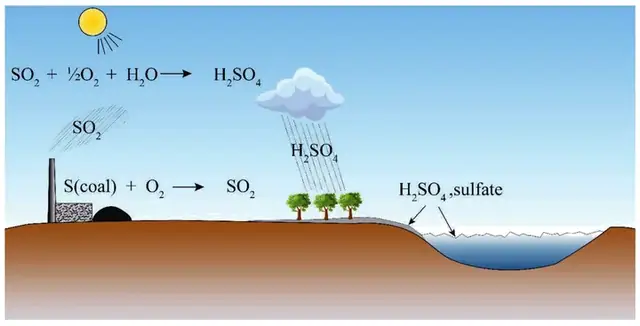
- Sulphur in coal is a classic example of a pollutant species.
- When coal burns, its sulphur is oxidised to sulphur dioxide gas, which escapes into the atmosphere.
- In the air, SO₂ is slowly oxidised to sulphur trioxide and then converted to sulphuric acid, which falls back to Earth as acid rain.
- The acid affects a receptor such as plants, and finally ends up in a sink such as a lake or the soil, where it remains as sulphate.
- Source (burning coal): S(s) + O₂(g) → SO₂(g)
- Transport and reaction in air: SO₂(g) + ½O₂(g) → SO₃(g) (or written SO₂ + ½O₂ + H₂O → H₂SO₄)
- Formation of acid: SO₃(g) + H₂O(l) → H₂SO₄(aq)
- Effect: acid rain damages a receptor (leaves of plants, fish, buildings)
- Fate: the sulphuric acid ends in a sink (lake water or soil) as sulphate ions, SO₄²⁻
- The environment consists of four interconnected compartments (components): the atmosphere (air), the hydrosphere (water), the lithosphere (rocks and soil) and the biosphere (living things).
- Chemicals constantly move between these compartments, so a pollutant released into one of them usually reaches the others.
Read the full notes for all 4 sections, worked examples and figures, plus 5 exercises with step-by-step solutions, the Short Note and the unit review.
📑 Contents
- 5.1Introduction to Environmental ChemistryPreview
- 5.2Environmental Pollution🔒
- 5.3Global Warming and Climate Change🔒
- 5.4Green Chemistry and Cleaner Production🔒
✍️ Practice questions
5 questions from the Unit 5 quiz. Choose an answer, then check it.
- 1
Environmental pollution is generally defined as:
- AThe discharge of a solid, liquid, gaseous substance, or energy into the environment causing unwanted/harmful changes
- BOnly the release of radioactive materials
- CAny natural change in the ecosystem
- DThe presence of any chemical in nature
Show answer
A The discharge of a solid, liquid, gaseous substance, or energy into the environment causing unwanted/harmful changes
- 2
The three broad types of environmental pollution discussed in the unit are:
- ALight, sound, and thermal pollution only
- BPhysical, chemical, and biological pollution only
- CUrban, rural, and industrial pollution
- DAir, water, and land (soil) pollution
Show answer
D Air, water, and land (soil) pollution
- 3
Common air pollutants mentioned in the unit include:
- AOnly nitrogen gas
- BOnly water vapor
- CSO₂, CO₂, O₃, Pb, and Hg
- DOnly oxygen
Show answer
C SO₂, CO₂, O₃, Pb, and Hg
- 4
Acid rain is primarily formed when sulfur oxides and nitrogen oxides in the atmosphere:
- AEscape into outer space
- BConvert to sulfuric/nitric acid and fall back to Earth in precipitation
- CReact with each other to form salts only
- DConvert into pure water
Show answer
B Convert to sulfuric/nitric acid and fall back to Earth in precipitation
- 5
A major harmful effect of acid rain is that it:
- AImproves soil fertility significantly
- BHas no known negative effects
- CDamages buildings, aquatic ecosystems, and vegetation
- DIncreases atmospheric oxygen levels
Show answer
C Damages buildings, aquatic ecosystems, and vegetation