
Cell Reproduction
- In Grade 9 you learned that the cell is the basic structural and functional unit of life.
- What distinguishes living organisms from non-living things is their ability to reproduce, and this ability has a cellular basis: every new cell comes from a cell that already exists.
- In this unit you will study the cell cycle – the ordered sequence of events by which a cell grows, copies its genetic material and divides – the two kinds of nuclear division, mitosis and meiosis, what goes wrong when the cycle is not controlled (cancer), and the work of a renowned Ethiopian geneticist.
- Define the cell cycle and outline the series of events taking place in it.
- Identify the two types of cell division and explain the importance of cell division.
- Outline the stages of mitosis and meiosis and compare and contrast them.
- Recognise the occurrence of cancer cells due to failure to control the cell cycle.
- Appreciate the work of renowned Ethiopian geneticists.
- Before dealing with the cell cycle, refresh your memory of cell structure, particularly the nucleus, where the key processes of cell reproduction take place.
- A model of an animal cell (Activity 4.1) shows the cell membrane, cytoplasm, nucleus with its nucleolus, mitochondria, rough and smooth endoplasmic reticulum, Golgi apparatus, lysosomes and vacuoles; a plant cell model adds a cell wall and chloroplasts.
- The nucleus is important for cell division because it holds the chromosomes – the DNA that must be copied and shared equally between the daughter cells; the nucleolus inside it is the small dense body that makes ribosomes.
- The presence of a cell wall makes the cytoplasmic division of plant cells different from that of animal cells, as you will see.
- A cell cycle is a sequence of events that takes place in a parent cell as a means of distributing genetic material and thereby forming daughter cells.
- There are two main divisions of the cell cycle: interphase and cell division (the M phase).
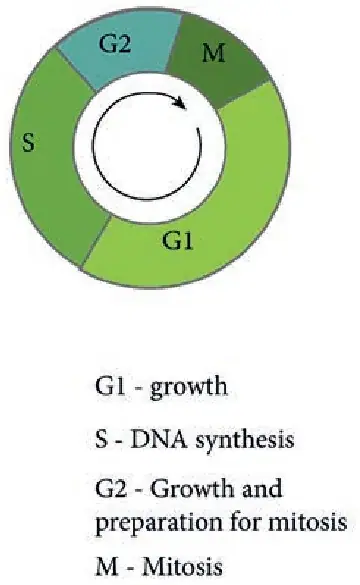
- Interphase is the long period of preparation between divisions.
- It is divided into three phases called G₁, S and G₂:
- G₁ phase (first gap) is the first stage of interphase. Cells are very active metabolically: they grow, accumulate the building blocks of chromosomal DNA and the associated proteins, and store sufficient energy reserves to complete the task of replicating each chromosome in the nucleus.
- S phase (synthesis of DNA) is the stage of DNA replication. Every chromosome is copied exactly, so that each now consists of two identical sister chromatids joined at the centromere.
Read the full notes for all 3 sections, worked examples and figures, plus 5 exercises with step-by-step solutions, the Short Note and the unit review.
📑 Contents
- 4.1Cell CyclePreview
- 4.2Cell Division🔒
- 4.3Renowned Ethiopian Geneticist🔒
✍️ Practice questions
5 questions from the Unit 4 quiz. Choose an answer, then check it.
- 1
The orderly sequence of events that a cell goes through as it grows and divides is called the:
- ACell cycle
- BCell wall formation
- CCell membrane process
- DCell theory
Show answer
A Cell cycle
- 2
The stage of the cell cycle in which the cell grows and carries out normal functions (before division) is called:
- ACytokinesis
- BMeiosis
- CMitosis
- DInterphase
Show answer
D Interphase
- 3
DNA replication (duplication of genetic material) occurs during which phase of the cell cycle?
- AProphase only
- BCytokinesis
- CS phase of interphase
- DMitosis
Show answer
C S phase of interphase
- 4
The type of cell division that produces two genetically identical daughter cells, used for growth and repair, is called:
- AFertilization
- BMeiosis
- CFermentation
- DMitosis
Show answer
D Mitosis
- 5
The type of cell division that produces four genetically different daughter cells with half the chromosome number, used for producing gametes, is called:
- ABudding
- BMitosis
- CMeiosis
- DBinary fission
Show answer
C Meiosis