
Micro-organisms
- Microorganisms (microbes) are organisms too small to be seen clearly with the unaided eye.
- Micro means very small – anything so small that it must be viewed with a microscope, an optical instrument used to observe very small objects.
- Microbiology is therefore the study of microbes.
- Individual microbes can be observed only with various types of microscopes; they include bacteria, archaea, fungi, algae, protozoa and viruses, and microbiology traditionally also covers the helminths (parasitic worms), whose eggs and larvae are microscopic.
- Some eukaryotic microorganisms (for example colonies of moulds, or large protozoa) are visible without magnification.
- Microscopic life is vital for all life on Earth: microbes decompose dead matter and recycle carbon, nitrogen, sulphur and phosphorus, fix atmospheric nitrogen, produce oxygen by photosynthesis, live in and on our bodies, ferment our foods and drinks (injera, kocho, tella, tej, ergo), make antibiotics and vaccines, clean up pollution – and a minority cause disease.
- Based on evolutionary lines (comparison of small-subunit ribosomal RNA gene sequences) all organisms are grouped into three domains: Bacteria, Archaea and Eukarya.
- Microbes are found in all three, while viruses are acellular and are not placed in any domain.
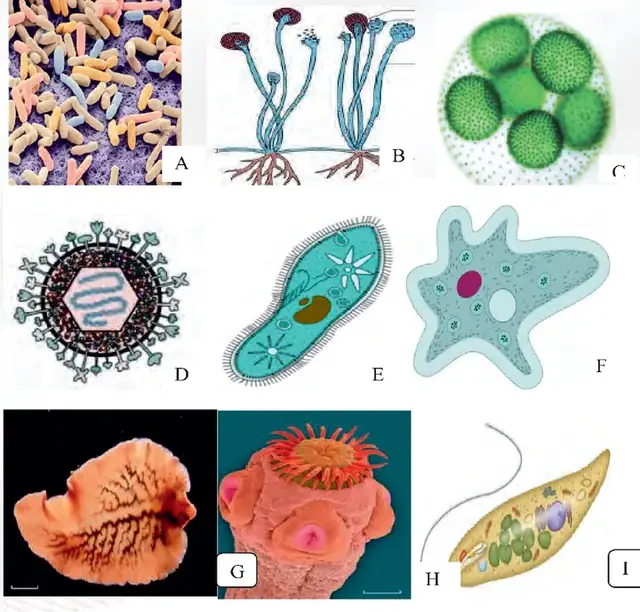
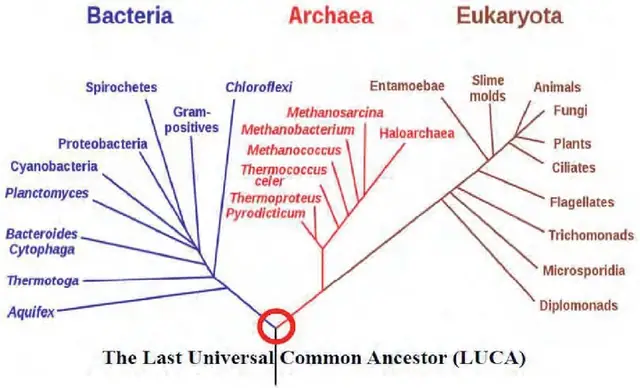
- State the characteristics of microorganisms and categorise them by morphology, mode of nutrition and molecular and biochemical analysis.
- Explain the different groups of microorganisms – eubacteria, archaea, fungi, protozoa and viruses.
- Explain the diseases caused by microorganisms and viruses and their ways of transmission.
- Describe the prevention and treatment mechanisms of diseases caused by microorganisms.
- Explain the significance of Koch’s postulates for the advancement of microbiological techniques and apply the principles of microbiological techniques.
- Discuss the economic importance of microorganisms in industry, agriculture and the environment, and appreciate the uses of microbiology in daily life.
- Eubacteria literally means “true bacteria”.
- Bacteria are relatively simple in structure: they are prokaryotic unicellular organisms with no nuclear membrane, mitochondria, Golgi bodies or endoplasmic reticulum, that reproduce by asexual division.
- A prokaryote is a unicellular organism that lacks a nuclear-membrane-enclosed nucleus; a eukaryote is an organism whose cells have a nucleus enclosed within a nuclear envelope.
- A unicellular organism has just one cell; a multicellular organism has more than one cell.
- They are omnipresent – present in soil, air and water (and in and on other organisms).
- They are unicellular, prokaryotic microorganisms.
- The cell bears a rigid cell wall made of peptidoglycan outside the plasma membrane (thick in Gram-positive, thin in Gram-negative bacteria).
- They show great variation in mode of nutrition – autotrophic or heterotrophic; heterotrophs may be parasitic, saprophytic or symbiotic.
- They lack true chlorophyll, but a few photosynthetic bacteria have a special type of chlorophyll called bacteriochlorophyll (cyanobacteria have chlorophyll a).
- They lack a true nucleus (no nuclear membrane and no nucleolus).
- They lack mitochondria, Golgi apparatus, plastids and endoplasmic reticulum.
- Both DNA and RNA are present in the bacterial cell.
- Because bacterial cells are very minute they are studied under the electron microscope, which reveals various structures – some external to the cell wall and others internal to it.
- The cell envelope consists of the cell wall (peptidoglycan), which gives shape and protects against osmotic lysis, and the cell membrane (plasma membrane), which controls what enters and leaves and is the site of respiration.
Read the full notes for all 11 sections, worked examples and figures, plus 12 exercises with step-by-step solutions, the Short Note and the unit review.
📑 Contents
- 2.1EubacteriaPreview
- 2.2Archaea🔒
- 2.3Fungi🔒
- 2.4Protozoa🔒
- 2.5Viruses🔒
- 2.6Normal Microbiota, Germ Theory and Koch’s Postulates🔒
- 2.7Modes of Disease Transmission and Ways of Prevention🔒
- 2.8Uses of Microorganisms🔒
- 2.9Controlling Microorganisms🔒
- 2.10Bacterial Isolation Techniques🔒
- 2.11Renowned Microbiologists in Ethiopia🔒
✍️ Practice questions
5 questions from the Unit 2 quiz. Choose an answer, then check it.
- 1
Eubacteria (true bacteria) are classified as:
- AProkaryotic organisms lacking a membrane-bound nucleus
- BNon-living particles
- CMulticellular organisms only
- DEukaryotic organisms with a true nucleus
Show answer
A Prokaryotic organisms lacking a membrane-bound nucleus
- 2
Gram's staining, a technique for distinguishing bacteria, was developed by:
- ARobert Koch
- BLouis Pasteur
- CHans Christian Gram
- DAlexander Fleming
Show answer
C Hans Christian Gram
- 3
Peptidoglycan, a component of bacterial cell walls, is composed of:
- AOnly lipids
- BN-acetylglucosamine, N-acetylmuramic acid, and amino acids
- COnly DNA
- DOnly cellulose
Show answer
B N-acetylglucosamine, N-acetylmuramic acid, and amino acids
- 4
Gram-positive bacteria, when stained using Gram's method, generally appear:
- AColorless
- BPink/red only
- CGreen
- DPurple/violet, due to a thick peptidoglycan layer retaining the crystal violet stain
Show answer
D Purple/violet, due to a thick peptidoglycan layer retaining the crystal violet stain
- 5
Gram-negative bacteria have a cell wall that is generally:
- AThicker in peptidoglycan than Gram-positive bacteria
- BThinner in peptidoglycan, with an additional outer membrane containing lipopolysaccharide
- CMade entirely of cellulose
- DCompletely absent
Show answer
B Thinner in peptidoglycan, with an additional outer membrane containing lipopolysaccharide