
Unit 4
Consumption, Saving and Investment
Introduction
- Adam Smith wrote that “consumption is the sole end and purpose of all production.” In Unit 3 you saw that consumption is the largest element of the gross domestic product (GDP) of an economy.
- This unit studies three closely linked macroeconomic variables: consumption, saving and investment.
- Together they decide how much of a nation’s income is used up today and how much is set aside to build the capacity to produce more tomorrow.
- The unit starts with the consumption function and its properties, including the average and marginal propensities to consume.
- It then derives the saving function from the consumption function and shows that every birr of disposable income is either consumed or saved.
- Section 4.3 links the two with the 45° line and the break-even level of income, and includes a case study of the Ethiopian iqub.
- The final section explains investment, its types and determinants, the real interest rate, the business environment and the accelerator theory.
🎯 Learning Outcomes
- Explain the relationship between consumption, saving and investment.
- Define consumption, disposable income and the consumption function, and distinguish autonomous from induced consumption.
- Compute the average and marginal propensities to consume (APC and MPC) and to save (APS and MPS).
- Derive the saving function from the consumption function and show that APC + APS = 1 and MPC + MPS = 1.
- Use the 45° line to identify the break-even income, positive saving and dissaving.
- Distinguish the main types of investment and outline the factors that affect investment.
- Appreciate the role of investment, and of informal saving such as iqub, in the economic growth of Ethiopia.
4.1 Consumption
- Consumption is the spending of households on goods and services that satisfy their wants now, such as food, clothing, rent, transport, medical care and school fees.
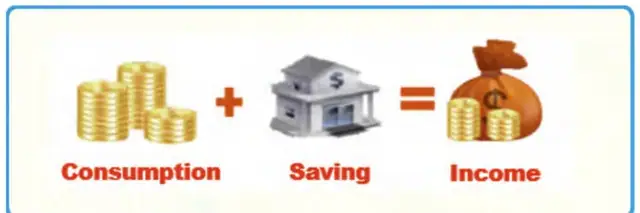
- A household can do only two things with the income it receives after tax: spend it on consumption or save it.
- In symbols, income equals consumption plus saving, .
- Figure 4.1 shows this idea in picture form.
🔒
The rest of Unit 4 is in the Danulearn app
Read the full notes for all 4 sections, worked examples and figures, plus 11 exercises with step-by-step solutions, the Short Note and the unit review.
📑 Contents
- 4.1ConsumptionPreview
- 4.2Saving🔒
- 4.3The Relationship between Saving and Consumption🔒
- 4.4Investment🔒
✍️ Practice questions
5 questions from the Unit 4 quiz. Choose an answer, then check it.
- 1
The Average Propensity to Consume (APC) is defined as:
- ATotal saving divided by total income
- BThe change in consumption divided by the change in income
- CThe change in investment divided by the change in income
- DTotal consumption divided by total income
Show answer
D Total consumption divided by total income
- 2
The Marginal Propensity to Consume (MPC) is defined as:
- ATotal consumption divided by total income
- BThe change in consumption resulting from a change in income
- CThe average saving rate
- DThe change in saving divided by income
Show answer
B The change in consumption resulting from a change in income
- 3
The Average Propensity to Save (APS) is defined as:
- ATotal consumption divided by income
- BThe change in investment
- CTotal saving divided by total income
- DThe change in saving divided by the change in income
Show answer
C Total saving divided by total income
- 4
The Marginal Propensity to Save (MPS) is defined as:
- AThe change in saving resulting from a change in income
- BTotal saving divided by total income
- CThe change in GDP
- DAverage consumption
Show answer
A The change in saving resulting from a change in income
- 5
For any given level of income, MPC and MPS together should sum to:
- AAn undefined value
- B0
- C2
- D1
Show answer
D 1