
Unit 5
The Human Body Systems
Introduction
- The human body is a biological machine made of body systems – groups of organs that work together to produce and sustain life.
- The human organ systems are the integumentary, skeletal, muscular, lymphatic, respiratory, digestive, nervous, endocrine, cardiovascular, urinary and reproductive systems.
- No system works alone: the muscles move the bones, the nervous and endocrine systems coordinate both movement and reproduction, and the circulatory system supplies all of them.
- In this unit only two of these systems are studied in detail – the musculoskeletal system and the reproductive system.
- The first part of the unit explains how muscles and bones give the body its shape, protect the vital organs and produce movement, from the sliding of actin and myosin filaments to the joints of the skeleton.
- The second part covers the male and female reproductive organs, the formation of gametes, the hormonal control of the menstrual cycle, fertilization and pregnancy, how contraceptives work, the causes of infertility and the major sexually transmitted infections (STIs) in Ethiopia.
- The unit ends with reproductive-health topics that matter to every young person: harmful traditional practices, family planning, and how alcohol, khat, cannabis and other drugs increase the risk of STIs and unwanted pregnancy.
🎯 Learning Outcomes
- Explain the structure and function of the musculoskeletal system.
- Identify the structures and functions of the male and female reproductive systems.
- Explain gametogenesis, the menstrual cycle and its hormonal (positive and negative feedback) control, fertilization and pregnancy.
- Describe how the different contraceptives work and the causes of infertility in men and women.
- Explain ways to prevent or reduce the spread of STIs and HIV.
- Explain family planning strategies.
- Examine the effects of alcohol, khat, cannabis and other drugs on the normal functioning of the musculoskeletal and reproductive systems.
- Identify harmful traditional practices that affect human reproductive health.
5.1 Human Musculoskeletal System
- The human musculoskeletal system is the organ system that gives humans the ability to move.
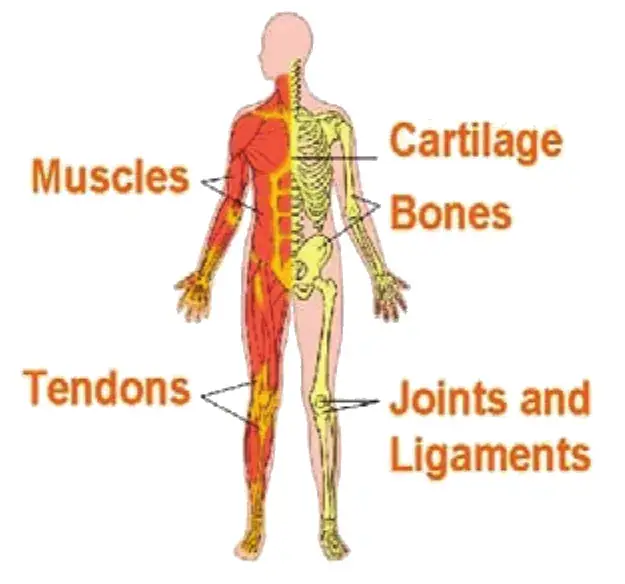
- It is made up of the bones of the skeleton, muscles, cartilage, tendons, ligaments, joints and other connective tissues.
- Together these structures give the body its shape and form, support it and keep it stable, bind organs together and protect the vital organs.
- The bones also produce blood cells in their marrow and store minerals such as calcium and phosphorus.
- Bones – the hard framework that supports the body, protects organs and acts as levers for movement.
- Muscles – hold the bones in place and pull on them to produce movement.
- Joints and cartilage – joints are the places where bones meet; smooth cartilage covers the bone ends and stops them rubbing against each other.
- Tendons – tough cords of connective tissue that attach muscles to bones.
- Ligaments – fibrous connective tissue that attaches bone to bone and holds joints together.
- Other connective tissues – bind and support the parts and help hold the body in position during movement.
5.1.1 Types of Muscles
- The human muscular system contains about 700 named muscles that are responsible for moving the body.
- Skeletal muscle alone makes up about 30–40% of total body mass.
- A skeletal muscle is a discrete organ made of skeletal muscle tissue together with blood vessels, nerves and connective tissue, and it is attached to the bones by tendons.
- Inside a muscle the cells (muscle fibres) are grouped into bundles called fascicles, each fibre is packed with myofibrils, and each myofibril is made of protein filaments (myofilaments).
- The muscular system has several functions.
🔒
The rest of Unit 5 is in the Danulearn app
Read the full notes for all 5 sections, worked examples and figures, plus 16 exercises with step-by-step solutions, the Short Note and the unit review.
📑 Contents
- 5.1Human Musculoskeletal SystemPreview
- 5.2The Reproductive System🔒
- 5.3Harmful Traditional Practices🔒
- 5.4Family Planning🔒
- 5.5Effects of Alcohol Use, Chewing Khat, Cannabis and Other Drug Use on STI Transmission and Unwanted Pregnancy🔒
✍️ Practice questions
5 questions from the Unit 5 quiz. Choose an answer, then check it.
- 1
The human musculoskeletal system is primarily composed of:
- AOnly the brain and nerves
- BBones, muscles, and joints
- COnly the heart and blood vessels
- DOnly the digestive organs
Show answer
B Bones, muscles, and joints
- 2
Skeletal muscle is characterized as being:
- AVoluntary and striated
- BUnable to contract
- CFound only in the heart
- DInvoluntary and smooth
Show answer
A Voluntary and striated
- 3
Cardiac muscle is found exclusively in the:
- AArms and legs
- BSkin
- CDigestive tract
- DHeart
Show answer
D Heart
- 4
Smooth muscle is typically found in the walls of:
- AThe heart only
- BThe skeleton only
- CInternal organs such as the stomach and intestines, and is involuntary
- DThe skin's outer layer
Show answer
C Internal organs such as the stomach and intestines, and is involuntary
- 5
The mechanism of skeletal muscle contraction is best explained by the:
- ALock and key model
- BInduced fit model
- CFluid mosaic model
- DSliding filament theory
Show answer
D Sliding filament theory