
Unit 4
Energy Changes and Electrochemistry
Introduction
- Burning charcoal gives heat, a battery lights a torch, and electricity from a power station can split molten salt into a metal and a gas.
- All of these involve energy changes in chemical reactions.
- This unit explains exothermic and endothermic reactions, how substances conduct electricity, how galvanic cells turn chemical energy into electrical energy, and how electrolysis uses electrical energy to drive a chemical reaction.
🎯 Learning Outcomes
- Describe energy changes in chemical reactions and distinguish exothermic from endothermic reactions.
- Use enthalpy diagrams, heat capacity and specific heat capacity to describe heat changes.
- Distinguish metallic conduction from electrolytic conduction, and electrolytes from nonelectrolytes.
- Describe how galvanic (voltaic) cells produce electricity: the Daniell cell, the dry cell and the lead-storage battery.
- Write oxidation half-reactions, reduction half-reactions and cell reactions for the electrolysis of molten electrolytes.
- Explain the differences between galvanic cells and electrolytic cells.
4.1 Introduction
- Chemical reactions almost always involve an energy change: the energy of the reaction mixture is different before and after the reaction.
- When coke (carbon) burns, C(s) + O₂(g) → CO₂(g), the chemical energy in the fuel is changed into heat and light.
- Natural gas burns in the same way: CH₄(g) + 2O₂(g) → CO₂(g) + 2H₂O(g) + heat and light.
- To study energy changes, scientists divide the universe into the system (the part being studied, such as a reaction mixture in a test tube) and the surroundings (everything else): Universe = System + Surroundings.
- Every particle in the system has potential energy (stored energy, held in chemical bonds) and kinetic energy (energy of motion).
- Their sum is the internal energy, E, of the system.
- When reactants change to products, the internal energy changes by ΔE = E(final) − E(initial) = E(products) − E(reactants), where Δ (delta) means 'change in'.
- The total energy of the universe stays constant: whatever energy the system loses, the surroundings gain, and the reverse.
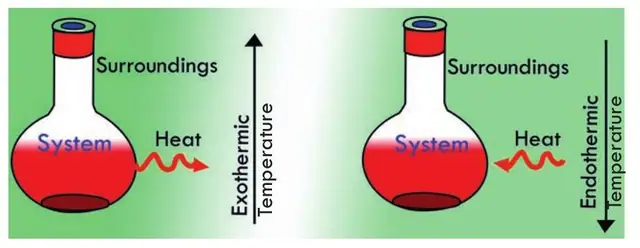
- Energy passes between system and surroundings as heat (q), as work (w), or both: ΔE = q + w.
- Burning petrol in a car engine does both — part of its chemical energy moves the car (work) and part heats the engine (heat).
4.1.1Exothermic and endothermic chemical reactions
- A reaction that releases heat to the surroundings is exothermic (Greek exo, outside; therme, heat).
- All combustion reactions are exothermic.
- Dissolving NaOH in water is exothermic too — the test tube becomes warm: NaOH(s) → Na⁺(aq) + OH⁻(aq).
- Dissolving calcium chloride in water also releases heat and warms the flask.
- A reaction that absorbs heat from the surroundings is endothermic (Greek endo, within).
🔒
The rest of Unit 4 is in the Danulearn app
Read the full notes for all 4 sections, worked examples and figures, plus 7 exercises with step-by-step solutions, the Short Note and the unit review.
📑 Contents
- 4.1IntroductionPreview
- 4.2Energy Changes in Electrochemistry🔒
- 4.3Electrochemical Cells🔒
- 4.4Electrolysis🔒
✍️ Practice questions
5 questions from the Unit 4 quiz. Choose an answer, then check it.
- 1
Every chemical reaction is accompanied by a change in:
- Acolour
- Bmass
- Cvolume
- Denergy
Show answer
D energy
- 2
The internal energy of a substance is the sum of its:
- Aenthalpy and entropy
- Bmass and volume
- Cpotential and kinetic energy
- Dheat and work
Show answer
C potential and kinetic energy
- 3
Potential energy is best described as:
- Astored energy
- Bradiant energy
- Csound energy
- Denergy of motion
Show answer
A stored energy
- 4
Chemical energy is a form of:
- Anuclear energy
- Bpotential energy
- Ckinetic energy
- Dlight energy
Show answer
B potential energy
- 5
Energy is transferred between a system and its surroundings as:
- Amatter
- Bwork only
- Cheat only
- Dheat or work or both
Show answer
D heat or work or both